Through the Bible with Les Feldick, Book 7
LESSON ONE * PART I
JACOB, ESAU, BIRTHRIGHT
Let's get back into the Book of Genesis and do some reviewing. Turn to Chapter
25. Here, we're dealing with two sons, Jacob and Esau, the sons of Isaac and
Rebekah. All of this is right in line with the Abrahamic Covenant. I realize
that a lot of people are picking up our program on television, and may have
been watching only a few weeks, so, sometime in the next couple of weeks we'll
make an extended review of that Abrahamic Covenant. I told a couple of my
classes recently, unless you understand the Abrahamic Covenant and all that it
entails, it's pretty hard to understand the New Testament. This also includes
our Age of Grace, prophecy, and the Middle East. The whole Middle East
situation is resting upon what we have back here in the Book of Genesis.
I've put a partial timeline on the board again, and we're going to look at it.
I think that a lot of people are going to be surprised at the time element that
takes place between so many of these things that we normally read, and think it
must have been only a week or two, when in actuality it was years. Because,
you want to remember, God promised Abraham that from His call to go to a land
that He would show him, which, of course, was Canaan, until Israel coming out
of Egypt, is going to be 430 years. God delineated that.
Now, we're going to see that in the very middle of that 430 years is when
Israel is in the beginning of her sojourn in Egypt. In other words, 215 years
of time elapse before the sojourn into Egypt even begins. I think we have all
been under the impression that the Israelites were in slavery and bondage for
the whole 430 years. Certainly, it was still a long time to be under those
circumstances, but in actuality it was only about 150 years that they were
slaves. Remember, as long as Joseph was on the throne, the Israelites had it
super good there in Goshen. It was after Joseph died that the slave situation
came in.
What I want to show you, before we get back into this timeline on the board, is
the Sovereignty of God. God is in control of every jot and tittle of what
takes place. Not only in the life of Israel, but, I think, in the life of
every child of God in particular. And as the old cliche once said, "The world
is His stage," and indeed it is. God is bringing it all to fruition in his
own time. Now, Genesis 25, and a little review:
Genesis 25:19-23
"And these are the generations of Isaac, Abraham's son:
Abraham begat Isaac:"
"And Isaac was forty years old when he took Rebekah to wife, the daughter of
Bethuel the Syrian of Padan-aram (That's north of present day
Damascus.), the sister to Laban the Syrian;"
"And Isaac intreated the LORD for his wife, because she was barren (She
was barren for almost 20 years. That was the time from when Isaac was 40 until
he was 60, and then the twins are finally born.): and the LORD was intreated
of him, and Rebekah his wife conceived."
"And the children struggled together within her (This is amazing that
the two personalities are already showing their mettle even in her womb.);
and she said, If it be so, why am I thus? And she went to inquire of the
LORD."
"And the LORD said unto her, Two nations are in thy womb (Now, what is
that? That's the sovereignty of God. He is bringing it all to pass, even
before they are born), and two manner of people shall be separated from thy
bowels; and the one people shall be stronger than the other people (I want
you to underline this next statement); and the elder shall serve the
younger."
Who mandated, then, that Jacob would end up where he did? God did! As we
study this, and especially when we come into the conniving of Rebekah and Jacob
to get that blessing from Isaac, never lose sight that God had mandated this
before they were even born. What I think we are going to see is a situation
just like Abraham, who got impatient with God's promise with regard to a son.
And without God's instruction he connived with his wife Sarah to bring about
the child Ishmael. This was all done in the energy of the flesh and yet it was
in God's sovereign plan. So keep these things in mind as we go back to Chapter
27 and pick up now the stolen blessing.
But, before we look at the Scripture, I want to lay this out on the board, just
a brief outline of the time element . About 2000 B.C. is when Abraham received
that call at Ur of the Chaldees. I put a question mark behind his age of 50,
because we don't know from Scripture. However, since the multiples of fives
(50, 75, 100, and he dies at 175) are so evident in the life of Abraham, I
think we can logically guess that God may have spoken to him at the age of 50
in Ur. Then he went up to Haran in Syria, where the relatives are still
living. And when Abraham was 75, God told him to go on down into Canaan. When
he is 86 his son Ishmael is born. And then when he is 100 years old Isaac is
born.
And now let's move over to the family coming out of Isaac. When Isaac is 40 he
marries Rebekah. And then 20 years later, when he is 60, the twins are born
and they are Jacob and Esau. When Isaac is 75, Abraham dies, being 175, so
Abraham is off the scene. When Jacob and Esau are 24 years old, Jacob got the
birthright by selling that bowl of red bean soup to Esau. There was no enmity
created from that, evidently; at least we don't see that in Scripture. Then
16 years after Jacob gets the birthright from Esau, Esau marries the Canaanite
women. Remember we touched on that last week, and the Canaanites were a grief
of mind to Isaac and Rebekah. I think that all of this indicates the kind of
man that Esau really was. Remember, I told you last week that he was a man
destitute of faith? He saw no importance whatsoever in that birthright at the
age of 24. It didn't mean a thing to him.
And what is so amazing (and I didn't pick it up until I was studying this more
in detail the last few weeks), is that normally, I've always thought it was
only a few weeks until Jacob connives with his mother to get the blessing, but
in actuality it was 37 years. Now, that shocks you doesn't it? It's 37 years
from the time they are 24 (when Jacob got the birthright), until he connives
with Rebekah and gets the blessing, and then he has to flee.
He goes up to Syria, back to where Abraham's relatives had been left off years
earlier. He goes up to Padan-aram. Then, 20 years later, we see Jacob coming
back with all of his wives and children; all 11 sons, and Benjamin will be born
after he comes back. Ten years after Jacob comes back to the land of Canaan,
Rachel dies giving birth to Benjamin. Then it's another 12 to 15 years (I
don't remember exactly), that Jacob joins again with Isaac down in southern
Israel, in Beersheba.
So Jacob, with all of his offspring, enjoys living several more years with his
father, Isaac, who dies at the age of 180. Jacob and Esau are now 120 years
old. Now, here is another interesting date. By the time that Isaac dies at
180, and Jacob is 120, Joseph is 29. He has already been down in Egypt for 12
years. Remember, his brothers sold him into slavery, after they took his coat
of many colors. Scripture says that Joseph was 17 at that time. Then, 64
years after Joseph dies, Moses is born. I hope this helps a little to put the
whole picture together.
So, from the time of the death of Joseph to Moses' birth, that brings us to
this 215 year mark, or exactly 1/2 of that 430 years that God mandated would be
from the Call of Abraham until Israel would leave Egypt. So that means that
the abject slavery was not the whole 430 years. It was more like 140 to 150
years.
Now, let's come back to Genesis 27. The twins are now 77.
Genesis 27:1-3
"And it came to pass, that when Isaac was old, and his eyes
were dim, so that he could not see, he called Esau his eldest son, and said
unto him, My son: and he said unto him, Behold, here am I."
Then the next verse makes you smile.
"And he said, Behold now, I am old, I know not the day of my death:"
Well, he must have had a spell of some kind and thought he was going to die.
However, he revived and didn't die for another 43 years.
"Now therefore take, I pray thee, thy weapons, thy quiver and thy bow, and
go out to the field, and take me some venison;..."
You all know the story, and we won't take it verse by verse for the sake of
time, but continue at verse 11:
Genesis 27:11-13
"And Jacob said to Rebekah his mother, Behold, Esau my brother
is a hairy man, and I am a smooth man:"
"My father peradventure will feel me, and I shall seem to him as a deceiver
(Remember that is what the name Jacob meant); and I shall bring a curse
upon me, and not a blessing."
"And his mother said unto him, Upon me be thy curse, my son: only obey my
voice, and go fetch me them."
We don't know what else happened to Rebekah. But if anything was a curse, the
one thing for sure was that after Jacob had to flee for his life, Rebekah never
saw him again. And that was the end of her association with her favorite son.
I think that, in itself, was enough to break her heart. Of course Isaac lived
on and, as I have mentioned, Jacob spent quite a few years with him after he
returned with his families.
Genesis 27:14,15
"And he went and fetched, and brought them to his mother: and his mother
made savoury meat, such as his father loved."
"And Rebekah took goodly raiment of her eldest son Esau, which were with her
in the house, and put them upon Jacob her younger son:..."
"And Rebekah took (note the next words) goodly raiment,..." Now, underline that
word "goodly" because there is a lot more to that word in the Hebrew
than just a nice garment. It was a word that designated the role of the
eldest. This is still the custom in the middle east even today. The eldest son
is given clothes that pertain to his position. Remember how mad the other sons
got when Jacob gave Joseph the coat of many colors? Well, they saw that their
father was designating Joseph as the head of the brethren, even though he
wasn't the eldest. What Rebekah is doing then, is taking this designated piece
of clothing for Esau and putting it on Jacob. This is all done in the flesh,
but God doesn't stop it, because he had mandated that this is way it would be.
They were merely fulfilling what God had mandated in the first place.
In verse 16 there is another word I want you to underline, and that word is
"kids." I'm not going to tell you "why" right now, but I will when we
get a couple of chapters farther on. The Old Testament says you sow to the
wind and reap whirl winds. In the Book of Galatians, Paul says you reap what
you sow. And here in Oklahoma we use the saying, "What goes around comes
around." And you can just count on it.
Genesis 27:16-19
"And she put the skins of the kids of the goats upon his hands, and upon the
smooth of his neck: In other words she's uses the kid to deceive;"
"And she gave the savoury meat and the bread, which she had prepared, into
the hand of her son Jacob."
"And he came unto his father, and said, My father: and he said, Here am I;
who art thou, my son?"
"And Jacob said unto his father, I am Esau thy firstborn;"
Now, we've got to stop for a moment. I used to almost cringe when I taught
that. How could Jacob tell a bold faced lie? But, again, you must look at it
in the light that God himself had designated that Jacob was to have the role of
the firstborn. So, in that light, Jacob was not lying. He was in his position
of the first born. I suppose you still think he lied. But according to the
way God reckons things, this is exactly where Jacob must be. We may ask was
God unfair? NO! Because what had God seen in the make up of Esau? NO FAITH!
And what does Hebrews 11:6 say? "Without faith it is impossible to please
God."
So, no matter how morally good Esau might have been (and I doubt that he was,
because of his marriage to the Canaanites), even if he was a better man than
Jacob, God couldn't use him because he had no faith. Now it is the same way
today. The reason people are turned off by Christianity, the reason they have
no desire for spiritual things is that they are destitute of faith. They
cannot believe that this is the Word of God. Most say unless you can prove
some of these things, they can't believe. And listen, God doesn't have to
prove anything, because He is Sovereign. He has spoken it! And He has every
right to expect mankind to believe what He has spoken.
So that Jacob, when he said, "I'm your firstborn son," according to how God
mandated it, he didn't lie.
Genesis 27:20-23
" And Isaac said unto his son, How is it that thou hast found it so quickly,
my son? And he said, Because the LORD thy God brought it to me."
This is another statement that we have a hard time swallowing, and on the other
hand you must look at the way God had mandated it.
"And Isaac said unto Jacob, Come near, I pray thee (Don't think the old
father didn't know that one son was hairy and one was smooth. So he said),
that I may feel thee, my son, whether thou be my very son Esau or not."
"And Jacob went near unto Isaac his father: and he felt him, and said, The
voice is Jacob's voice, but the hands are the hands of Esau."
"And he discerned him not, because his hands were hairy, as his brother
Esau's hands: so he (what?) blessed him."
And you need to remember that, in the ancient middle eastern world, when even
the pagan kings made a decree, it could not be broken. An example is the Book
of Esther. Right or wrong it stood. It's the same way here. I think I
pointed it out in our last program, but time flies by and I'm prone to forget.
The birthright was the spiritual side of the family position. The eldest son
was more or less the priest of the family. He was the spiritual leader. But
with this little family coming out of Abraham, it's more than just being the
family priest. It is through this line that the promised Messiah would come.
This makes it so very important, that God's sovereign will is accomplished.
Esau, being born first, could have been in the line of the Messiah, but he
canceled it because of his lack of faith. So it fell to Jacob. Jacob then got
the birthright, not really by deceiving, since Esau was willing to sell it for
a bowl of soup. There was nothing iniquitous about that as far as I can see.
And, consequently, I think that's the reason we don't find any hard feelings
between them from the time they are 24 until Jacob flees.
So, this birthright issue did not create the enmity that this blessing did.
And the reason of course was that the blessing was the material side of the
whole picture. Now, the material side said that the eldest son would get a
double portion. So, if there were three sons, immediately the father would
divide the estate into four parts. The oldest would get two parts and the
others would get one part each. In Isaac's case, he would divide the blessing
into three parts, with the oldest getting two, and the other, one.
This was what Esau was so angry about; he didn't want to give up this double
portion. And you need to remember this was a very wealthy family. They had
flocks, herds, servants, and even old Abraham had a good collection of gold and
silver. Always remember the birthright never did bother Esau, because that was
something spiritual; he only wanted the material things. And I hope this helps
settle this matter in our minds.
_______
LESSON ONE * PART II
JACOB, ESAU, BIRTHRIGHT
Continued...
Let's get ready for our next lesson, but before we begin I would just like to
thank the group here in the studio. We know you put out a lot of effort to
come in for these classes and, as I've said so often, I just couldn't teach
unless I had folks in front of me that are my friends. I know you are praying
for us and that makes all the difference in the world.
We trust that everyone that comes in contact with our teaching is learning, and
you can take it into your Sunday School classes, or whatever, and teach more
efficiently.
Now, if you will come back to Chapter 27 of Genesis (I'm hoping we'll be ready
for the book of Exodus in the next couple of lessons). You will recall that
Rebekah and Jacob have connived, there is no doubt about it. Esau now appears
on the scene. He has slain his deer, and has prepared it the way that Isaac
likes, so let's start at verse 30:
Genesis 27:30-33
"And it came to pass, as soon as Isaac had made an end of
blessing Jacob..."
You remember I pointed out in the last lesson, that the blessing was the double
portion of the material estate. And that's, of course, why Esau was intensely
interested in this legacy. The birthright didn't interest him. It didn't
cause any turmoil; as we pointed out, there was no enmity, or hard feelings
over the birthright. That didn't mean a thing to Esau. But, oh, this blessing
- now that's something different. We're getting into his pocketbook. And so,
as soon as Isaac had finished making a blessing on Jacob, Esau comes in as
we've seen in verse 30:
"...and Jacob was yet scarce gone out from the presence of Isaac his father,
that Esau his brother came in from his hunting."
"And he also had made savoury meat, and brought it unto his father, and said
unto his father, Let my father arise, and eat of his son's venison, that thy
soul may bless me."
"And Isaac his father said unto him, 'Who art thou?' And he said, 'I am thy
son, thy firstborn Esau.'"
He gives the same answer that Jacob did. Of course, he's speaking from the
physical reality. He was, indeed, the firstborn, but so far as God is
concerned, Esau is second.
"And Isaac (What's the next word?) trembled..."
Now, stop and ask yourself, why do you suppose Isaac suddenly breaks into a
trembling? Number one, I think he was scared to death of what Esau might do.
Now, maybe I'm wrong, but I think Esau was the kind of man that Isaac realized
was very capable of hurting old Isaac for what he had done. That's just a
thought, but we have to realize that Esau is a man destitute of faith, and when
people are destitute of faith, it affects their behavior. In fact, we were
talking about this last night after our class, and how this is affecting our
beloved country.
I was speaking with a lady who works with teenage girls who have become
pregnant and so forth. She said, what they are finding is that, these
teenagers have no sense of right and wrong. No one is teaching them. They
just don't comprehend that violence is wrong, or that there's such a thing as
immorality. And you see, faith changes that. When you are a person of faith,
you automatically know right from wrong.
But Esau was a man destitute of faith, and incapable of knowing right from
wrong and Isaac realized that. When he saw that Esau was upset, Isaac began to
tremble and he said:
Genesis 27:33b-34
"....where is he that hath taken venison, and brought it me,
and I have eaten of all before thou camest, and have blessed him? yea, and he
shall be blessed."
In other words, Isaac isn't going to take the blessing back. Now, let's look
at verse 34:
"And when Esau heard the words of his father, he cried with a great and
exceeding bitter cry, and said unto his father, Bless me, even me also, O my
father."
Oh, can you hear a son that is really pouring out his heart, broken over the
fact that he has missed this material blessing. Now, I think we looked at it a
couple or three weeks ago, and let's go back again to Hebrews Chapter 12 and
see what the New Testament says about this man, Esau. And then I think you can
comprehend a little more of why God, in His sovereignty, designated that Jacob
would be in the line of the Messiah, rather than this man Esau. Hebrews
Chapter 12 and go to verses 16 and 17. I'm sure we looked at them a couple of
weeks ago, but let's read them again. (I might mention that I think Paul wrote
Hebrews. I think there is evidence enough in some of his language that there's
no doubt).
Hebrews 12:16,17
"Lest there be any fornicator, or profane person, as Esau; who
for one morsel of meat sold his birthright."
"Lest there be any fornicator (that is an immoral person), or profane
person, as Esau (there you've got the Scripture's description of
this man Esau. He was immoral, he was profane); who for one
morsel of meat (that was the bowl of bean soup, remember, back there
in the earlier time) sold his birthright." It didn't bother him
a bit. He didn't get irate over that. And then verse 17:
"For you know how that afterward (37 years later), when he would have
inherited the blessing (or the double portion) he was rejected: for he
found no place of repentance, though he sought it carefully with tears."
Now, I think again, we can apply this attitude of repentance to, not only Esau
himself, but also to the one he was hoping would change his mind. His father!
And I think, possibly, this is what the Scripture is saying - that old Esau was
so distraught, that he thought through his weeping and crying he could get
Isaac to change his mind. But Isaac wouldn't because that just wasn't the
custom. And then, of course, he was also bewailing the fact that he had now
missed the birthright and the blessing. We need to understand that all
of Esau's problem goes back to the same thing we had with the man, Cain.
Cain had the same opportunity that Abel had. But what was his problem? No
faith! He didn't see any significance in what God said. And so it is with
Esau. He sees no significance in spiritual things. And again, let me bring it
up to our own day and time. Isn't that exactly where we find so many of our
fellow people, right here in America. They see absolutely no need to believe
what God says. They can get along fine without Him. They think they're doing
all right. They just cannot comprehend that God has said there is an eternity
coming. There's a judgment coming. And even though they may think they can
get along without God for 70 or 80 years, there's coming a day.
There's a famous old preacher, Southern Baptist I think, who had a sermon that
he preached hundreds of times, from what I've read. The title of it was,
"Payday Someday." And it's true. There's going to be a payday someday
for every last human being that's ever been born. Because God's Word says so.
But they just refuse to believe it. Let's go on now to verse 35 in Genesis
Chapter 27:
Genesis 27:35,36
"And he (Isaac) said, 'Thy brother came with subtilty,
(with deception) and hath taken away thy blessing.' And he
(Esau) said, 'Is not he rightly named Jacob?'"
You must remember the definitions of all these Hebrew names were definite. And
Jacob meant "the deceiver," "the supplanter," where as Israel meant literally a
"prince with God." So what we are going to see in the conversion of Jacob
later on is the man is going to be changed from a deceiver and supplanter to a
prince with God. Now, isn't that what should happen to everyone of us.
When we are in our lost state what are we? We are sinners, rebels, nothing,
we're enemies of God. But once salvation has come in, there should be that 180
degree turn. The first thing I look for when someone claims to have been saved
is that change in life style. It just has to happen! And I've seen it over
the years, in so many people, where there is a total change. It might not
happen overnight. It may take time. The Christian life is a growth process,
just like an infant coming into the world. And they, too, must be fed, and
nurtured, and loved as they grow. And so it is with the Christian
experience.
Genesis 27:36b-38
"And he (Esau) said, 'Is not he rightly named Jacob?
for he hath supplanted me these two times: he took away my birthright...
(Now, that's not true. Jacob didn't take away his birthright. He was
simply in a position where he could say, "Esau I've got this food that you
want, and I'll trade it for your birthright." And that's the way it
happened) ...and, behold, now he hath taken away my blessing... (yes, we
have to admit he did do that) "hast thou not reserved a blessing for
me?"
"And Isaac answered and said unto Esau, Behold, I have made him thy lord
(I had to point out to someone recently, this word "lord" in small letters
is just a term of address. In other words, today we would say, "Dear Sir."
But here the word "lord" is simply a designation of addressing someone. So
this is what Isaac means when the tells Esau that he has made Jacob his
oversee: "Positionally he is above you, he's thy lord"), and all his
brethren have I given to him for servants: and with corn and wine have I
sustained him: and what shall I do now unto thee, my son?"
"And Esau said unto his father, Hast thou but one blessing, my father? bless
me, even me also, O my father. And Esau lifted up his voice, and wept."
This is what the Book of Hebrews meant that he sought this thing with tears. I
think what we must understand, that in spite of all the weeping and wailing
that Esau went through, did it change his status of faith? Not one
bit! Esau doesn't come out of this experience and say from now on
I'm going to believe what God says. We can even relate to this today.
Individuals may go through an emotional upheaval and I am not very much in
favor of emotionalism on these things. because people can be forced by emotions
to do things that they don't really mean.
I have a little cliche that goes like this: "Anyone convinced against
their will is unconvinced still." I had someone give me a perfect
illustration of that not very long ago. Someone had brought people into their
home to watch our first video tape. They watched it, and immediately after
that, someone tried to force them to get on their knees and become a Christian.
Listen, that is not the way it works. That's not the way God does things. He
opens hearts and it may take time for that heart to become receptive. I've got
people in my classes that I've taught two years or longer, before they came to
that place. And God has to do it in His own time. Oh, you can force people,
you can bring them to an emotional high and force them to do something that
they don' really mean, and that's Esau. He is still destitute of faith,
as we are going to see at the end of this chapter. But as a result of all
of this, we come down to verse 41
Genesis 27:41
"And Esau hated Jacob"
Usually, when you run into the word "hate" in Scripture, this has thrown a
curve at a lot of people. Jesus, in His earthly ministry, said unless you hate
your father and mother you cannot be His disciple. And that has bothered
people. It is used in another place also. Turn to Malachi:
Malachi 1:2,3
"I have loved you (speaking of Israel), saith the LORD.
Yet ye say, Wherein hast thou loved us? Was not Esau Jacob's brother? saith
the LORD: yet I loved Jacob, And I hated Esau, and laid his mountains and his
heritage waste for the dragons of the wilderness."
Anywhere the Scripture uses the word hate, at least as so far as God is
concerned (remember it's a comparative word), it merely means that his love for
Jacob was so much greater than it was for Esau. It was as if it was a hatred.
But remember, God can't hate, because hate is a sin. So always look at that
word in it's context , and realize that it is only a comparative term. So,
getting to the verse Jesus used about hating your father and mother or you
can't be His disciples, it didn't mean he expects people to hate their parents,
as we look at the term. Rather, our love for the LORD should be so much
greater than for our earthly parents, that by comparison, it's the difference
between love and hate. Maybe that will help a little bit.
Now, back to Genesis 27:41. Here, I think Esau is using the word hate as the
term we understand it to be. When the Scriptures said, "And Esau hated
Jacob" how long has that hatred lasted? Right up even to today. This is
the crux of all the problems of the Middle East today. Remember, they are all
relatives. I pointed that out several months ago when I put the genealogy on
the board, how all those middle eastern nations come out of Terah, and Abraham
and his two brothers. And out of those three brothers, we had Lot. And Lot
had the Moabites, and the Ammonites, Then on the other side you have Ishmael, a
son of Abraham, though they are relatives, they are outside the Abrahamic
Covenant. So they became enemies of God's Covenant people.
Genesis 27:41b-44
"And Esau said in his heart, 'The days of mourning for my
father are at hand (He, too, thought that Isaac was about dead); then
will I slay my brother Jacob.'"
"And these words of Esau her elder son were told to Rebekah: and she sent
and called Jacob her younger son, and said unto him, 'Behold, thy brother Esau,
as touching thee, doth comfort himself, purposing to kill thee.'" She had
caught wind of Esau's statement.
"'Now therefore, my son (She's speaking to Jacob), obey my voice; and
arise, flee thou to Laban my brother to Haran;'" (That was north of
Damascus)
"'And tarry with him a few days, until thy brother's fury turn away;'"
She thought Esau would cool off and Jacob could come back home maybe within a
month or two. But how long did it turn out to be? Twenty years - and Rebekah
never lived to see Jacob again.
Genesis 27:45,46
"'Until thy brother's anger turn away from thee, and he forget
that which thou hast done to him: then I will send, and fetch thee from thence:
why should I be deprived also of you both in one day?'"
Do you realize what Rebekah is really saying? Do you know what they were
practicing? Capital punishment. She knew that if Esau murdered Jacob,
she would also lose Esau, because that's what the law demanded. And wouldn't
we be in better shape if that was true in our country today? Note, they didn't
have God's Law yet. Most of these people lived their daily lives according to
the old ancient laws of Hammurabi. He was a Babylonian and, of course, when
Moses came on the scene, that was all superseded. Nevertheless, Hammurabi's Law
demanded whoever murdered, he himself would also lose his life. And they
didn't have four or five years of appeals. Rebekah said "in one
day." Had Esau killed Jacob, his own life would have been taken in
a matter of hours.
"And Rebekah said to Isaac, I am weary of my life because of the daughters
of Heth: If Jacob take a wife of the daughters of Heth, such as these which are
of the daughters of the land, what good shall my life do me?
Who previously had taken daughters of Heth? Esau had. He had already married
two of these Canaanite women. And it was a grief of mind to Isaac and
Rebekah.
Genesis 28:1-4
"And Isaac called Jacob, and blessed him, and charged him, and
said unto him, 'Thou shalt not take a wife of the daughters of Canaan.'"
We see that Isaac is in full accord with all of this, even though he recognizes
that Jacob may have deceived him. Yet Isaac is comfortable with the whole
setting. Otherwise, I don't believe you would see him calling Jacob back and
giving him those instructions. The Canaanites were pagan, immoral and
idolatrous, yet Esau was comfortable with them. But Isaac and Rebekah don't
want Jacob to get involved with the Canaanite women.
"'Arise and go to Padan-aram, to the house of Bethuel thy mother's father;
and take thee a wife from thence of the daughters of Laban thy mother's
brother.'"
At this point, the race is still relatively pure. They had a gene pool that
allowed such a custom without having any repercussions.
"'And God Almighty (if you remember, several months ago we pointed out
the names of Deity, and this word Almighty is the Hebrew word El Shaddai. It
is always used in association with fruitfulness, as you see here) bless
thee, and make thee fruitful, and multiply thee, that thou mayest be a
multitude of people;'"
You want to be looking for these various terms of Deity because it makes the
Scripture so beautiful and fine-tuned as it's been put together.
"'And give thee the blessing of Abraham, to thee, and to thy seed with thee;
that thou mayest inherit the land wherein thou art a stranger (That is
Canaan), which God gave unto Abraham.'"
Wouldn't it be great if our State Department could just understand Genesis?
They could save themselves so much grief, if they could just know that the land
between the Mediterranean and the River Jordan was given to the Nation of
Israel 4000 years ago. And God never goes back on His Word.
I remember reading a secular history book several years ago, dealing with the
antiquities, and do you know that even before God designated the Holy Land to
Abraham, the ancients, the ones that were on the scene before Abraham, were
already calling the land of Palestine the Divine Land, or God's Land. For some
reason, they already knew that this land was a special God-designated piece of
real-estate.
_______
LESSON ONE * PART III
JACOB'S WIVES AND TWELVE SONS
Let's turn back again to Genesis 28 We will pick up where we left off
in our last lesson.
We were studying about the Almighty (El Shaddai) and how He is going to make
Jacob fruitful. Now I must point out that Jacob is still an unbeliever.
He is the perfect picture of the Nation of Israel as a whole. He is going to
be sent out into a far country, out of the Land of Promise. He's going up into
Syria, and even though he's up there in unbelief, God still has His hand on
him.
And this is what so many people today can't comprehend. I have to remind
folks, even in our class last night, that if you take the Nation of Israel
today, their government is just as secular, and no more godly than any other
government on the face of the earth. And don't expect them to be any
different. But, who is watching out for that little nation?
Almighty God is!
I've said it over and over throughout the years, that God loves the Arab as
much as he does the Jews. He loves Americans just as much as the
Middle-Easterners, because this is the day of Grace. But, going back to His
Covenant promises, God has delineated that the Nation of Israel is His chosen
and Covenant People, and He is going to bring to fruition all of those promises
He made to Abraham. That is why the little nation is in the news everyday.
Even though they are out numbered, no one dare attack them. We all know right
today, Syria has been fiercely building up their armed forces. And for all
practical purposes, you would have to say that Syria could overrun Israel in a
day or two. But, Almighty God is holding everything in check!
How would we feel if all of a sudden Mexico and Canada, and other nations would
attack us? That's exactly what happened to Israel in the six-day war in 1967.
They were invaded from four different directions all at once. And yet, in a
matter of hours, they turned the tide and literally destroyed those Arab
armies. Now, what was that? That was a miracle of a Sovereign God!
Even though they are for the most part in unbelief. So it is with Jacob; he's
going to be under the protection of The Almighty God. But he himself is still
an unbeliever. He is still the deceiver, and supplanter. He is still Jacob.
Genesis 28:5-7
"And Isaac sent away Jacob: and he went to Padan-aram unto
Laban, son of Bethuel the Syrian, the brother of Rebekah, Jacob's and Esau's
mother."
"When Esau saw that Isaac had blessed Jacob, and sent him away to
Padan-aram, to take him a wife from thence; and that as he blessed him he gave
him a charge, saying, Thou shalt not take a wife of the daughters of Canaan;"
(Which Esau had already done of course.)
"And that Jacob obeyed his father and his mother,..."
Even in his unbelief, he has just enough faith, that he obeyed his parents, but
it was enough that Esau could see that Jacob obeyed his father and had gone.
Genesis 28:8-10
"And Esau seeing that the daughter of Canaan pleased not Isaac
his father;..."
Now Esau tries to do two wrongs and make a right. And it just doesn't work.
It was bad enough to marry Canaanites, but now he takes one step worse, and
what does he do? He marries daughters of Ishmael.
"Then went Esau unto Ishmael, and took unto the wives which he had Mahalath
the daughter of Ishmael Abraham's son, the sister of Nebajoth, to be his
wife."
"And Jacob went out from Beersheba, and went toward Haran"
Now we come to the story of Jacob on his way to Haran, where he has a dream.
Genesis 28:12-15
"And he dreamed, and behold a ladder set up on the earth, and
the top of it reached to heaven: and behold the angels of God ascending and
descending on it."
"And, behold, the Lord stood above it, and said, 'I am the LORD God of
Abraham thy father, and the God of Isaac: the land whereon thou liest, to thee
will I give it, and to thy seed:'"
Now, there you have it, The Abrahamic Covenant repeated again, and
again, and again.
"'And thy seed shall be as the dust of the earth, and thou shalt spread
abroad to the west, and to the east, and to the north, and to the south: and in
thee and in thy seed shall all the families of the earth be blessed.'"
Now, what is that Seed? That Seed is The Christ? The Messiah. It would be
through the promised Messiah, that all the nations of the world, someday, would
receive the blessing of God.
"'And, behold, I am with thee, and will keep thee in all places whither thou
goest, and will bring thee again into this land (Canaan); for I will not
leave thee, until I have done that which I have spoken to thee of.'"
Genesis 28:16-18
"And Jacob awaked out of his sleep, and he said, 'Surely the
LORD is in this place; and I knew it not.'"
"And He was afraid, and said, 'How dreadful is this place! this is none
other but the house of God, and this is the gate of heaven,'"
"And Jacob rose up early in the morning, and took the stone that he had put
for his pillows, and set it up for a pillar, and poured oil upon the top of
it."
In verse 19 he names the place that becomes famous in Scripture. If you will
notice, in "Bethel" you have the two letters el which is a short, or
contraction of Elohim and Beth simply means house in Hebrew. So
this place is called the House of God. Later on, when he comes back, he calls
another place El Beth-el, for he had met face to face the God of the
House of God. Do you see that? All of these words are so significant.
Genesis 28:19a-22
"And he called the name of that place Beth-el,"
"And Jacob vowed a vow, saying, If God will be with me, and will keep me in
this way that I go, and will give me bread to eat, and raiment to put
on,"
"'So that I come again to my father's house in peace; then shall the LORD be
my God:'"
Is He Jacob's God yet? No. I think that he's bargaining with God. It's sort
of akin to a lot of battlefield statements where men say, "Lord if you will
just bring me through this I'll serve you." But as yet, Jacob is not a true
believer.
"'And this stone, which I have set for a pillar, shall be God's house: and
of all that thou shalt give me I will surely give the tenth unto thee.'"
Here again we have that tenth which has been in the Scriptures since
Abraham gave the tenth of the spoil. Now, in Chapter 29 we want take it verse
by verse, but first we find Jacob coming to the house of his relatives, and
immediately he runs into the flocks of his Uncle Laban:
Genesis 29:6
"And he said unto them, 'Is he well?' (Asking about
Laban) And they said, 'He is well: and, behold, Rachel his daughter cometh
with the sheep.'"
Here, we are introduced to the apple of Jacob's eye. And it was love at first
sight. Everyone knows the story, and we won't go through that verse by verse.
But what happened? Jacob was deceived himself this time. It's interesting as
you read the story, and I would encourage you to read the story again, when you
have time. Jacob, the deceiver, meets his match with his Uncle Laban. I'm
convinced these two are two of a kind. They are constantly hoodwinking each
other.
Jacob has love at first sight of Rachel, and eventually comes to his wedding
night. Remember it was dark. Today with all the security lights it's hard to
find a dark place, but that's not the way it was back then. And so it was no
problem whatsoever for Laban to convince Leah, Rachel's older sister, to go in
as the bride. For after all, Laban can't let Rachel become his wife when Leah
is the eldest. So the wily Laban pulls one on Jacob before Jacob even gets
started.
When it become daylight, instead of Rachel, the bride is Leah the oldest
sister. Of course, Laban had a logical excuse. He said it's the custom of his
country that the younger daughter cannot have a husband until the eldest is
married. So he makes a deal with Jacob, that if Jacob would serve him another
seven years (and this is beyond the seven that Jacob had promised to serve for
Rachel), then he could also have Rachel. There's one thing I want you to
understand. Jacob did not wait until the fourteen years were up before
marrying Rachel. He had both Leah and Rachel from day one, but his contract
calls for fourteen years of service in order to have them both.
As you go through those chapters, where Jacob is there with Laban those twenty
years, you'll see he has the two wives, Leah and Rachel. Leah will have six
sons herself, and then she becomes barren. And as was the custom of that day
(and God seemingly did not disapprove of it), he also had sons by Leah's
handmaid. Finally, Rachel also has some sons by her handmaid. That gives
us ten sons by now. And then Rachel has Joseph. Ten years after
they are back in the land of Canaan, Rachel gives birth to Benjamin to make a
total of twelve sons. However Rachel dies during childbirth to
Benjamin.
Now, those twelve sons are the setting for the Nation of Israel. I would hope
that everyone clearly understands the Nation of Israel comes about by Abraham's
son Isaac, Isaac's son Jacob, and Jacob's twelve sons from which we get the
TWELVE TRIBES OF ISRAEL. It will be those twelve sons that wind up in
Egypt. But now, Jacob is coming back from Haran. He's been there twenty years,
and remember old Laban and Jacob have been hoodwinking each for those twenty
years, but Jacob has finally gotten the upper hand. He's got his wives and
children, and the best of the flocks, and herds. So he comes back with quite a
caravan.
Now lets come over to Chapter 31. Word comes back to Laban, that indeed, Jacob
and Laban's daughters, and the children are leaving. But the important verse
I want you to see is verse 30. I've been teaching that, since the Tower of
Babel, everyone on the face of the earth of the then-known world were
idolaters. Then God called Abram out of idolatry, and Abram becomes a man who
worships the one true God, as does Isaac, and we are going to see that Jacob
will. But other than this family, they are all idolaters, even the relatives
up there in Syria. Now, here it is in verse 30, where Laban catches up with
Jacob's caravan. He says:
Genesis 31:30
"'And now, though thou wouldest needs be gone, because thou sore longest
after thy father's house, yet wherefore hast thou stolen my gods?'"
Notice it is a small "g." What kind of gods? They were his
idols. Here is another thing that most people miss. Why was Laban so
concerned about a bunch of little images? They were the family gods. And
according to the pagan customs of that day, the child who received the
blessing, was also the child to whom the family gods were given. Now, that
meant something, if you had the family gods, you had it all. So Rachel,
knowing that, slips them out without her father knowing about it, and she takes
them along, and has them hidden.
Genesis 31:34-36
"Now Rachel had taken the images, and put them in the camel's
furniture, and sat upon them. And Laban searched all the tent, but found them
not."
"And she said to her father, 'Let it not displease my lord that I cannot
rise up before thee; for the custom of women is upon me.' And he searched, but
found not the images." Oh he looked but didn't find them.
"And Jacob was wroth, and chode with Laban: and Jacob answered and said to
Laban, 'What is my trespass? what is my sin, that thou hast so hotly pursued
after me?'"
Then they go into a conversation of accusing and re-accusing each other. They
finally make an agreement, or treaty, and in verse 55 we read:
Genesis 31:55
"And early in the morning Laban rose up, and kissed his sons and his
daughters, and blessed them: and Laban departed, and returned unto his
place."
Genesis 32:1-3
"And Jacob went on his way, and the angels of God met
him,"
"And when Jacob saw them, he said, 'This is God's host (You see Jacob is
aware of all of these things that God is doing, but he is still not a "heart
believer"): and he called the name of that place Mahanaim.'" In the
Hebrew it means the two hosts. The one of course was God's host, and the other
his own.
"And Jacob sent messengers before him to Esau his brother..."
And, here again, you know the story of how Jacob sends this tremendous gift of
livestock and wealth to appease his brother. But evidently Esau has forgotten
his bitterness and there is no problem. Now, I want to come to verse 22.
Jacob has divided some of his flocks and his family - he has sent them over the
brook and is heading down to Canaan to meet Esau.
Genesis 32:22
"And he rose up that night, and took his two wives, and his
two women servants, and his eleven sons, and passed over the ford
Jabbok,"
Jabbok was a little stream that flowed into the Jordan from the east. Probably
just below the Sea of Galilee.
Genesis 32;24-26
"And Jacob was left alone; and there wrestled a man with him
until the breaking of the day."
"And when he saw that he prevailed not against him (In other words when
the stranger saw that he could not overcome Jacob), he touched the hollow of
his thigh; and the hollow of Jacob's thigh was out of joint,"
In other words, he crippled Jacob. And from this point on, Jacob walks with a
limp - it's called a halt in Scripture. And the stranger said:
"Let me go, for the day breaketh. And he said, 'I will not let thee go,
except thou bless me."
That was quite a wrestling match wasn't it. It must have gone on nearly all
night. Now, does Jacob know who the stranger is? You bet he
does! And who is it? The LORD himself. Now, here is what we call a
theophany. It's a great big word that simply means the appearance of God in
human form. And anytime there is a theophany in the Old Testament it's always
God The Son. This is Christ, in other words, in an Old Testament
appearance in human form, and He has literally been wrestling, flesh and blood
with Jacob all night long.
Right there is the statement of Jacob's faith! Simple? Absolutely! He
suddenly realizes that he is dealing with the God of his father, Isaac, and his
Grandfather, Abraham.
Genesis 32:27,28
"And he (The LORD) said unto him, What is thy name?
And he said, Jacob." (the deceiver, the supplanter.)
"And he said, 'Thy name shall be called no more Jacob, but Israel: for as a
prince hast thou power with God and with men, and hast prevailed,'"
There is Jacob's salvation! Now he becomes a child of God. Never again does
the Scripture give the account of Jacob the deceiver. Never again will you
find Jacob trying to cheat someone. He is now a changed man, and that is why
God changes his name. From the deceiver to the prince with God. Every
good Bible student should understand these two terms; Jacob and Israel. Many
times they seem to be used synonymously, however they are not synonymous. It
is the same nation, but it's two aspects of that nation.
Isaiah 9:8
"The LORD sent a word into Jacob, and it hath lighted upon
Israel."
Do you see what that is saying? God sent the word into the whole nation into
Jacob, but who heard it? The believers, the spiritual part of Jacob. So you
will see this all through Scripture. Let's go to Romans for another Scripture
concerning this.
Romans 9:6
"Not as though the word of God hath taken none effect; For
they are not all Israel, which are of Israel:"
See the distinction? In other words Israel too has a believing remnant. They
are all called the house of Jacob or the Sons of Jacob, or Abraham. But Israel
was that spiritual element of true believers. Paul tells us here in Romans
that all of Israel will be saved:
Romans 11:26
"And so all Israel shall be saved: as it is written, There
shall come out of Zion the Deliverer, and shall turn away ungodliness from
Jacob:"
And it's that same connotation - of course all Israel will be saved. Every
believer in Israel, but that doesn't mean the whole nation. So always keep
those two pictures sorted out in your mind. Now, let's come back to Genesis.
Genesis 32:29,30
"And Jacob asked him, and said, Tell me, I pray thee, thy
name, And he said, Wherefore is it that thou doest ask after my name? And he
blessed him there." Now only God can do that. And if you doubted what I've
been telling you, look at the next verse.
"And Jacob called the name of the place Peniel: for I have seen God face to
face, and my life is preserved."
Always remember, no man has seen the Triune God, the Trinity, the Spirit part
of God, but they have seen God the Son all through the Old Testament. Remember
Abraham in Chapter 18, what did he do? He killed the fatted calf, and he sat
down and ate. Who was it with? It was God the Son. At the burning bush (and
we'll see that in a few weeks), who was it? It was God the Son. So, remember,
no man has seen God face to face in the Trinity, but Jacob saw God the Son face
to face and his life was preserved.
_______
LESSON ONE * PART IV
JOSEPH - SOLD INTO EGYPT: PICTURE OF CHRIST
Once again, we're going to get into the Book, starting with Genesis 36. And
now, as is always the case, you look first at the natural posterity, which in
this case is Esau, and the spiritual. It's always been the case. First
Cain, and then Seth, and so on down the line. Ishmael and Isaac,
and then Esau and Jacob. In Chapter 36, we won't go through all these
names. They don't mean that much to us except for one which we find in verse
12:
Genesis 36:12
"And Timna was concubine to Eliphaz, Esau's son; and she bare
to Eliphaz (who?) Amalek:"
Now, who in the world is Amalek? I've got you thinking haven't I? Do you
remember when Israel came out of Egypt, under Moses. They were heading down to
Sinai. What was the first war they had to fight? The Amalekites. And they
all stemmed from these relatives of Esau And that's what makes it
so interesting. Statistically, where do most murders take place? Within the
family! Because that's where all the affiliations are, the closeness - that's
where feelings are generated the quickest. So, consequently, it's among that
environment then, that our passions and emotions seem to get the best of us.
It's the same way here. All these relatives become arch-enemies as you follow
through the Old Testament history. I just wanted to make note of the fact that
the Amalekites originated from one of the offspring of Esau. Now, let's go on
over to Chapter 37, where we'll pick up once again with Jacob.
Genesis 37:1
"And Jacob dwelt in the land wherein his father was a
stranger, in the land of Canaan."
Now Jacob has come back from Haran after twenty years of herding Laban's sheep.
He came back with his wives, his eleven sons, then Rachel has Benjamin and she
passes off the scene. But now, we are introduced to Joseph. And Joseph almost
fills the rest of the Book of Genesis. Again, this is one of those areas of
Scripture that I seldom treat verse by verse because I feel that almost
everyone knows the story of Joseph better than I do. You know all that he went
through down there in Egypt, and everything else. But there are a few things
I'd like to point out. Let's look at verse 2:
Genesis 37:2,3
"These are the generations of Jacob. Joseph, being seventeen
years old, was feeding the flock with his brethren; and the lad was with the
sons of Bilhah (You remember that was one of the maid servants of the girls
up in Syria), and with the sons of Zilpah, his father's wives; and Joseph
brought unto his father their evil report."
"Now Israel (Jacob) loved Joseph more than all his children..."
I've put a few things on the chalk board and we're not going to take time to
look at them verse by verse. But just remind yourself that in the life of
Joseph, we have so many things that (what shall I say?) will be repeated almost
exactly in the life of Christ. And so Joseph is that Old Testament picture
of Christ.
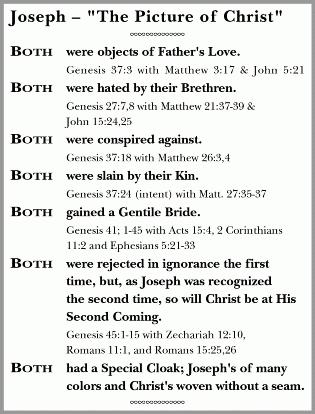
Number one, Christ was The Son of The Father - the Beloved Son, whom the Father loved intrinsically. And so was Joseph. Joseph was given the coat of many colors. And again, it goes back to what I taught you a few lessons ago. Why was there a special cloak given to the favored, or to the eldest son? Now Christ, of course, had a special cloak. What was unique? It was seamless. It was woven of one seam from top to bottom. Then, they were both hated and rejected by their brethren.
When Joseph tells his brothers about his various dreams; and how that he sees eleven sheaves and they all bow down to his sheaf; what did his brothers pick up? "Hey, this guy is telling us we're going to bow down and worship him!" And that really burned them up. Now, when Christ came to the nation of Israel, what did He claim? That He was their King! And what did they say? "We have no king but Caesar. Crucify Him! Away with Him!" So they were both hated and rejected by their brethren. Then, of course, for all practical purposes, so far as type is concerned, when they cast Joseph into the pit, they considered him dead.
Now, we know that the Ishmaelites came along, and there again, you have a type of resurrection. Even though he was dead, yet, he is alive and so of course was Christ. Then after they are taken for dead and they have been restored to life, both Joseph and Christ, they take what kind of a bride? A Gentile. Joseph ends up down in Egypt and takes an Egyptian bride. Christ is exiled, you might say, from His rightful throne in Jerusalem, as the King of Israel. And He went back to heaven, and you remember what God the Father said in Psalm 110:1, "...Sit at my right hand until I make your enemies your footstool." And then He's going to return.
The same thing happened with Joseph. He was sent down into a far country. He was rejected by his brethren. He takes an Egyptian bride, but while he's there, you recall the brothers come down the first time to get their grain. Did they ever find out it was Joseph? No! They didn't recognize him. And yet Joseph gave them some little hints and it just blew their minds. You know what one of them was? When he set up a banquet for them, he put them all at the table according to their age, from the eldest to the youngest. And they couldn't believe it! They said, how does he know the eldest from the youngest? And they had no idea who Joseph was.
Now, it was the same way when Jesus came on the scene. Should they have known who He was? Sure, they should have! But they didn't. They had no idea that He was the promised Messiah. Oh, a few did, but the nation as a whole, never understood. Keep your hand here in Genesis and go forward with me to I Corinthians, Chapter 2. Let's continue reading at verse 7. Now, Paul of course is writing to the Gentile congregation at Corinth. Look what he says:
I Corinthians 2:7,8
"But we speak the wisdom of God in a mystery (Or a secret), even the hidden wisdom, which God ordained before the world unto our glory."
In other words, there was the foreknowledge of God that Paul would be where he is.
"Which NONE of the princes of this world knew (Now that meant Romans as well as Jewish): for had they known it" (Known what? Who Jesus was) they would not have crucified the Lord of Glory."
That stands to reason, doesn't it? Had the Romans really known who Christ was, do you think they'd have put Him on that Cross? Never! Had the high priests of Israel known that He was the very Creator, God of the Universe, would they have allowed it? No! So why did it happen? They did not know. Now, let's go back to Genesis and this is so beautifully put there, in type - in picture form - illustrated, that these brothers of Joseph, were totally dependent on the grain that he had gathered in the seven good years to carry them through the seven lean. And yet they had no idea of who he was. And even some of the things that transpired, sent things reeling through their mind, but they couldn't put it together. So, as you come all the way over to Genesis 37, as they have rejected Joseph and they are conspiring to put him to death, let's look at verse 20:
Genesis 37:20
"Come now therefore, and let us slay him (Joseph), and cast him into some pit, and we will say, Some evil beast hath devoured him, and we shall see what will become of his dreams."
Now, when they are concocting what they are going to say, what are they setting up? A deception! And who are they going to deceive? Oh, the master of deception - Jacob! Alright, let's go on:
Genesis 37:21,22
"And Reuben heard it (The eldest), and he delivered him out of their hands; and said, Let us not kill him."
"And Reuben said unto them, Shed no blood, but cast him into this pit that is in the wilderness (Out there in the desert) and lay no hand upon him; that he might rid him out of their hands...."
In other words, Reuben was conspiring by himself to have the brethren throw him into the pit, and then when they didn't know it, he'd go back and draw him out and send him back home. So Reuben was really trying to be a benefactor here. And he doesn't get away with it.
Genesis 37:-23-25
"And it came to pass, when Joseph was come unto his brethren, that they stripped Joseph out of his coat, his coat of many colors that was on him;"
"And they took him, and cast him into a pit; and the pit: was empty, there was no water in it."
And then in verse 25, underline this
"And they sat down to eat bread: and they lifted up their eyes and looked, and, behold, a company of Ishmaelites came from Gilead with their camels bearing spicery and balm and myrrh, going to carry it down to Egypt."
They threw him into a pit, and for all practical purposes, they were killing him and then they did what? They sat down! Now, what does that remind you of? When Christ was put on the Cross, what does it say they did? And they sat down and they watched him there. Isn't that beautiful? Oh, it's such a perfect picture of what would transpire thousands of years later. And they sat down to eat their bread. Now, let's continue on and read the rest of 25 - we can't skip that. "...and behold a company of Ishmaelites came from Gilead with their camels bearing spicery and balm and myrrh, going to carry it down to Egypt." Now, let's go on:
Genesis 37:26-28
"And Judah said unto his brethren, What profit is it if we slay our brother, and conceal his blood?"
"Come, and let us sell him to the Ishmaelites, and let not our hand be upon him; for he is our brother and our flesh, And his brethren were content."
"...and they drew and lifted Joseph out of the pit, and sold Joseph to the Ishmaelites for twenty pieces of silver:..."
They sold Joseph to the Ishmaelites for twenty pieces of silver; (although that number is a little different, they sold Christ for how much? Thirty pieces of silver. But, nevertheless, the analogy is so close that you can't avoid it.)
Genesis 37:29
"And Reuben returned unto the pit, and behold, Joseph was not in the pit; and he rent his clothes."
Reuben was responsible because he is the eldest. How can he dare go back to his father and tell him what had happened. Then we'll see in verse 31 that they all conspire together:
Genesis 37:31
"And they took Joseph's coat, and killed a kid of the goats, and dipped the coat in the blood;"
Now, is the bell ringing? What did Rebekah use to deceive Isaac? The kid. Previously, I said what goes around comes around. What do the brethren use to deceive old Jacob? The kid! Now, I think little tidbits like this make this great old Book so interesting. You can't escape some of these things. It's always going to come back, even in these old patriarchs. What goes around comes around. And so they took the kid, and they dipped the coat of many colors in it's blood. Let's go on:
Genesis 37:32-34
"And they sent the coat of many colours, and they brought it to their father; and said, 'This have we found: know now whether it be thy son's coat or no.'"
"And he knew it, and said, 'It is my son's coat; an evil beast hath devoured him; Joseph is without doubt rent in pieces.'"
"And Jacob rent his clothes, and put sackcloth upon his loins, and mourned for his son many days."
And, of course, we know how that Jacob went through tremendous mourning for the loss of his son, Joseph.. And then in Chapter 39, we have all that happened to Joseph and, like I said, most of you probably know the story as well, or better, than I do. All that he went through, first in the house of Potiphar, and then because of his chastity, he ends up down in prison.
Now in Chapter 49 you get to the blessings that Jacob puts on his twelve sons. The one son that was most unchaste; the one who was the most promiscuous; who did the most awful deed was Reuben, the eldest. I know that most of you are aware of what he did. But, actually, he committed adultery with one of Jacob's wives. And evidently nothing was ever said of it - until you get to old Jacob's deathbed.
And then, as he begins to put the blessings on these twelve sons, he starts with Reuben, and you know what he brings to mind? He said Reuben is not going to have the birthright, or the blessing. He's not going to be esteemed as the eldest, because he committed adultery with one of his wives. And seemingly, no one else ever knew it. So how Jacob found out, the Scripture doesn't tell. But it came back, and Reuben suffered the consequences of it.
And then Joseph, the one who maintained his chastity back here under all the pressures, he ends up with the blessings. It was passed on to his two sons, but, nevertheless, Joseph is finally elevated to the place of seniority over all the others. God keeps records, He keeps track. Now let's go over to Chapter 45. I surely would like to finish Genesis in this program, so we'll be ready for Exodus when we come back for the next one. In Chapter 45 the brethren have come down to Egypt to get grain. But they're here for the second time. And I want you to keep that in your mind, because when we get into Exodus, I'm going to refer back to this, that Israel has always got to have a second time, it seems. But now in Chapter 45, as the brethren have come up again for grain, let's start in verse 1:
Genesis 45:1,2
"Then Joseph could not refrain himself before all them that stood by him; and he cried, 'Cause every man to go out from me.' And there stood no man with him, while Joseph made himself known unto his brethren."
"And he wept aloud: and the Egyptians and the house of Pharaoh heard."
He wept. A weeping of what? A reunion! I've always got to use another Scripture verse. Turn with me to Zechariah. The next to the last book in your Old Testament. And you're going to have much the same thing happening when Christ returns and the nation of Israel suddenly, as a nation, will realize who He is (This is speaking of Christ, of course). And then you have this great event.
Zechariah 12:10
"And I will pour upon the house of David, and upon the inhabitants of Jerusalem, the spirit of grace and of supplications: and they shall look upon me whom they have pierced (Who are the 'they?' Oh, The Israelites, the Jews)... and they shall mourn for him."
There's going to be a time for weeping. A reunion that the One they rejected, the One they crucified, the One they killed, is finally their God. And that New Covenant will become a reality, and every believing Jew will suddenly know that He is their God and they are His people. Come back quickly to Genesis 45, where we see there was a session of weeping as they begin this great reunion.
Genesis 45:4,5a
"And Joseph said unto his brethren, Come near to me, I pray you. And they came near. And he said, 'I am Joseph your brother, whom ye sold into Egypt.'"
"'Now therefore be not grieved, nor angry with yourselves, that ye sold me hither:...'"
Now, remember again everything that has happened to Joseph, and a lot of it was pretty miserable. Why? Because it was all in God's sovereign plan. There are a lot of things that God does that we can't understand. But, you see, He does things in His own way, according to His own will. Joseph knew that. But in spite of all those horrible times he had gone through, yet the years of blessing came.
Genesis 45:5b
"...for God did send me before you to preserve life."
And had it not been for Joseph in Egypt, the 12 sons would have probably faded off the scene in the famine - they would have died. But God in His providence had prepared everything. Another thing I want you to see is that when the brethren hated and rejected Joseph and put him to death (so far as they were concerned), and he ends up in Egypt; remember that all of this shows us that so often, the Lord Jesus Himself, had to go through all these rejections, in order to bring about the whole plan of salvation - that He could die for us and extend salvation by grace. And yet all of this is so beautifully laid out in the life of this man, Joseph. God is Sovereign in everything He does.
Genesis 45:7
"And God sent me before you to preserve you a posterity in the earth, and to save your lives a great deliverance."
I'd like to have you come all the way down to Chapter 46. Now, the sons of course, have gone back home to Canaan and naturally, they've told old Jacob that Joseph is alive and is the head man in Egypt. Also that Joseph has permission from Pharaoh to bring all of the family down into the best part of Egypt, right there by the Nile River, into Goshen. As we've studied, God has been telling Abraham, Isaac, and Jacob, not to leave the land of promise. Remember, He told Isaac back there in Chapter 26, "Sojourn in this land and I will bless you." Now, these guys knew that. But with this invitation to come back to Egypt, Jacob is probably stammering a little bit. But God comes to his rescue.
Genesis 46:1-2a
"And Israel took his journey with all that he had, and came to Beersheba, and offered sacrifices unto the God of his father Isaac."
"And God spake to Israel....."
Now, you see we're talking in the terms of his spiritual side. Jacob the spiritual man. Let's go on:
Genesis 46:2b-3
"...in the visions of the night, and said Jacob, Jacob (God uses both names for Jacob right here - Israel and Jacob). and he said, Here am I." Now, God returns and says:
"And he said, I am God, the God of thy father: fear not to go down into Egypt; (Underline that last statement, if you don't mind underlining in your Bible.) for I will there (in Egypt) make of thee a great nation."
Now, if you ever wonder where did the nation of Israel come from, there's your answer. It was when the 12 sons and all their wives and children end up in Egypt, because Joseph has the food. But, again, another thought we'd like to bring in, is that when these brethren rejected all this, for all practical purposes, Israel now ends up in a place of out of God's control, or in a place of death, nationally. They're out of the land of promise. They're down in Egypt and for all practical purposes, God has lost His Covenant People .
The reason I'm trying to make that point before we get to Exodus is because I'm going to point out that Exodus is a book of redemption. And redemption always means only one thing and what is that? You buy back that which you have lost control of. In other words, if you hock something in a pawn shop, there's only one way you can get control of it and that is to go in a redeem it. You buy it back. And it is the same in every aspect of business: if you have lost control of something, you have to redeem it. When Adam sinned, God lost the human race. And what does He have to set up? A plan of redemption. When the brethren sold Joseph down into Egypt, and all 12 sons end up there, as a result of their sin, God loses control of His Covenant People. And He's going to have to buy them back.
This is all in His sovereign plan, of course, but Israel is going to end up in Egypt, and while they're in Egypt, they're going to become a nation of people. I think the best thing we can remember is that at this point in time, when Jacob finally goes down into Egypt (as I said in one of the earlier lessons), we are now in the middle of that 430 year time span that God had foretold. 215 years have elapsed from the call of Abraham until Jacob goes down into Egypt. There's 215 years left. As I've mentioned earlier, as long as Joseph is alive everything goes well with the Israelites. They have it pretty good in Goshen. It's a productive area by the Nile River and they prospered. And as they prospered, they multiplied.
Oh, we can't imagine how much they multiplied. But again, keep the time element in mind. We're talking 215 years. I always have to remind people, that's as long as America has been a nation! And we've gone from a few thousand people to 270 million people.
_______
LESSON TWO * PART I
REVIEW OF JOSEPH
If you remember last lesson, we were winding up the Book of Genesis. And as one gentleman wrote in one of his letters, tongue in cheek I'm sure, "By the time you finish Genesis will you be through the Bible?" He was close, but not quite. We're going to review just for a moment or two, and then we'll be ready to go into the Book of Exodus.
So, let's turn now to Genesis 46, because I've made it a point over the years to make it so plain where the nation of Israel came from, because I had several people who had taught Sunday School for years that never really knew where the Jew come from in the first place. When did Israel become a nation? As we've been studying now for the last several months, it all began when God called Abraham out of the midst of idolatry. I always have to stress that the whole human race was steeped in paganism and idolatry. No one had a knowledge of the one true God. But God saw in that man Abraham a potential for faith, and so He revealed Himself to him, and told him to leave Ur with his family and go to a place that He would show him later. We now know that was the land of Canaan.
Then, you remember, from Abraham we have the Covenant, and that was passed on to Isaac. Isaac in turn had two sons, Jacob and Esau. We saw that Esau was destitute of faith so Jacob ascends to the place of having the birthright and the blessing. It's through Jacob that the Messiah would come, the Seed of the woman of Genesis 3:15. Then Jacob went back up to his kinfolk in Syria, married Leah and Rachel up there, and with a couple of women servants, he has 12 sons. And those 12 sons and their families, by virtue of Joseph being sold into Egypt earlier, they all end up in Egypt because of the famine.
You all know the story of the seven years of good production. Joseph piled up the grain and foodstuff in order to carry the world of that time through the seven years of famine. He had the grain and food and the other 11 brothers, and old Jacob and the family, were about the starve to death in Canaan. Then they found out there was grain in Egypt and you remember the story - how they all end up in Egypt, where Joseph, being the second highest man in Egypt, was able to give them the very fruit of the land. That would be the land of Goshen, around the Nile River. And so in the area of Goshen those 12 sons are then the setting for the population explosion that we will see when we come into the Book of Exodus.
All through the sojourning, from the time that God called Abraham and told him that he would have a nation of people coming out of his loins and from his own wife (even though she was now well passed child-bearing time), yet the promise was always associated with the stipulation that if they would stay in the land, the land of promise, then these things would come to fruition. I've had you turn to Genesis 46, but you see, under the circumstances and in God's sovereign plan in bringing all this to pass, He finally tells Jacob in no uncertain terms to go on down into Egypt. Let's look at it:
Genesis 46:3
"And he said, I am God, the God of thy father; fear not to go down into Egypt; for I will there (in Egypt) make of thee a great nation."
Now, lock that into your computer. You see, God's time table is so exact, that when He told Abraham that it would be 430 years, that's exactly what it was. So it's in that time period, 215 years, from Abraham until Jacob goes down into Egypt with all of his offspring. Another 215 years, while they'll be in Egypt under slavery, will fill the 430 years. Exodus tells us that the day they left Egypt was exactly 430 years.
Now, just one other little comment out of the Book of Genesis and that is in Chapter 50, the very last Chapter. Let's just look quickly at verse 22-26 because again, the word of God is so accurate. I told one of my other classes, I want people to get to the place where you can believe every word, of this book even though there are things that we can't quite put together and can't quite understand. And it may almost seem illogical at times, but BELIEVE IT!!! It's the Word of God and God does not lie nor make mistakes.
Now, of course, we always have to remember that our Bibles are translations. Our Bible may contain a little error here and there, because they are translations. But when we say that the Word of God is without error and that it's perfect, we're talking about the originals. And on the other hand, I've always maintained that God has been so jealous of His Word, that He has not permitted a gross error to come in. There may be a word or two here or there, and maybe a number that could very easily have lost it's original through the process of translation, but you can believe it! The Word of God is true and the more you study it, the more true it becomes. So now, let's look at verse 22 of Chapter 50:
Genesis 50:22,23
"And Joseph dwelt in Egypt, he, and his father's house: and Joseph lived an hundred and ten years."
"And Joseph saw Ephraim's children of the third generation (Remember Ephraim was Joseph's son);... the children of Machir the son of Manasseh were brought up upon Joseph's knees."
Genesis 50:24-26
"And Joseph said unto his brethren, (In other words to the rest of the family of Jacob) I die: and God will surely visit you, and bring you out of this land (Egypt) unto the land which he sware to Abraham, to Isaac, and to Jacob.'"
Now those three names just keep popping up all the way through Scripture, well into the New Testament.
"And Joseph took an oath of the children of Israel, saying, 'God will surely visit you, and ye shall carry up my bones from hence (In other words, back to Canaan).'"
"So Joseph died, being an hundred and ten years old: and they embalmed him, and he was put in a coffin in Egypt."
And so ends the Book of Genesis, the Book of Beginnings. This Book that starts, "In the beginning God created...," but it ends with, of all things, a coffin. Death. Always remember, and this is not original with me - God buries his servants, but never his programs.
Now, we are at the Book of Exodus. Israel has been in Egypt over 200 years. The children of Israel are multiplying, and God is about ready to fulfill the promises He made to Abraham, Isaac, and Jacob. He will now take them into the land that He had delineated in the Abrahamic Covenant. Remember, Exodus is a Book of Redemption, as we mentioned last program. You see, this is the entire matter of buying back something He had once owned but had lost. This is the whole idea of man's redemption itself. That which God had in the beginning with Adam and Eve (He fellowshipped with them, everything was perfect), until sin entered. Sin separated Adam and Eve from God, and, of course, out of the garden, and immediately what did God have to institute? A plan of redemption. To be able to buy back, and pay the price for that which He lost control of. Now, it's the same way here with Israel. It was the sin of the brothers selling Joseph into slavery that started the ball rolling, where God lost control of His Covenant people. They are now down in Egypt. And now He is going to redeemed them.
Exodus 1-1
"Now these are the names of the children of Israel, which came into Egypt; every man and his household came with Jacob." Of course the sons are all mentioned here. But drop down to verse 7:
Exodus 1:7-9
"And the children of Israel were fruitful, and increased abundantly, and multiplied (That word multiplied in the Hebrew almost speaks of swarming. So this wasn't just a casual increase. They had a real population explosion)..., and waxed exceeding mighty; and the land was filled with them."
"Now there arose up a new king over Egypt, which knew not Joseph."
Right here, you need a little knowledge of ancient history. Back then, things were not any more stable than they are now. An empire could rise, and a line of kings could come on the scene, but it wouldn't be very long before someone that was stronger would come in and they would over-rule the Pharaohs and set up a new line of kings. History indicated the line of Pharaohs who had been on the throne from the time of Joseph coming on the scene, were friendly with the Israelites. But along comes a new king who didn't know Joseph, and had nothing to do with any agreement the Israelites might have had with previous Pharaohs:
"And he said unto his people, Behold, the people of the children of Israel are more and mightier then we:"
How would we feel as Americans, if we looked up one day and we were out-numbered by another nation, right here in our own country. We might get a little defensive, also. So you can see how the Pharaohs and Egyptians must have felt.
Exodus 1:10
"Come on, let us deal wisely with them; lest they multiply, and it come to pass, that, when there falleth out any war, they join also unto our enemies, and fight against us, and so get them up out of the land."
How many people do you suppose that Pharaoh and his Cabinet were looking at? Well I want you to forget the few thousand that were in the Movie - The Ten Commandants. It's millions, and if you doubt me on that, let's look at Numbers Chapter 22. Here in Numbers they have ended their 40 years of wandering, and Moses is leading them around to the Southeast of Canaan, through the land which was called Moab. And as they come across the land of Moab, their king gets just as worried as the Pharaohs did. I just want you to see where I get this figure of 3-7 million Israelites that will leave Egypt on the night of that Passover.
Numbers 22:4,5
"And Moab said unto the elders of Midian, 'Now shall this company of (Israelites) lick up all that are round about us, as the Ox licketh up the grass of the field...'"
"He sent messengers therefore unto Balaam the son of Beor to Pethor, which is by the river of the land of the children of his people, to call him, saying, Behold, there is a people come out from Egypt (now watch the language): behold, they cover the face of the earth, and they abide over against me:"
Of course, that's a play on words, but, nevertheless, in later verses when the King of Moab took Balaam up into a high mountain, and told him to look, he said, "you can't see the end of them." They went beyond the horizon, even from a high place. Now that's not a few thousand. That is millions. To give you an idea, Dallas and Fort Worth is approximately 3-4 million people. So when the children of Israel start their exodus from Egypt, I want you to picture something like Dallas/Fort Worth moving out all at once. Now, let's turn to Numbers 26:
Numbers 26:2
"Take the sum of all the congregation of the children of Israel, from twenty years old and upward, throughout their fathers' house, all that are able to go to war in Israel."
Numbers 26:51
"These were the numbered of the children of Israel, six hundred thousand and a thousand seven hundred and thirty."
When you have a little time, sit down and do some calculation. Using your own logic, see what you come up with. As you see from verse 2, the 601,730 in verse 51, were not all the children of Israel, but only that select few that were able to go to war in Israel. Normally, an Israel soldier was between the ages of 20-30 years old. How many other family members would be involved for one soldier, unmarried, between 20-30 years old? So, in order to get 601,730 young men of military capabilities, you would have to have a minimum of 3,000,000 people total when you are taking into account parents, grandparents, sisters, and other brothers not qualified for military service. And remember, there was also a mixed multitude that came out with them. Consequently, always figure between 3-7 million came out of Egypt. So now let's turn back to Exodus. In order to slow down this population explosion among the Israelites, we read:
Exodus 1:11-14
"Therefore they (the Egyptians) did set over them taskmasters to afflict them with their burdens. And they built for Pharaoh treasure cities, Pithom and Raamses."
"But the more they afflicted them, the more they multiplied and grew. And they were grieved because of the children of Israel."
"And the Egyptians made the children of Israel to serve with rigour:"
"And they made their lives bitter with hard bondage, in mortar, and in brick, and in all manner of service in the field: all their service, wherein they made them serve, was with rigour."
Exodus: 1:15-17
"And the king of Egypt spake to the Hebrew midwives, of which the name of the one was Shiphrah, and the name of the other Puah."
"And he said, 'When ye do the office of a midwife to the Hebrew women, and see them upon the stools (now, the word stools in the Hebrew was evidently a little hewn-out stone, where they would immediately wash the newborn); if it be a son, then ye shall kill him: but if it be a daughter, then she shall live.'"
Now, if the baby was a boy, they were supposed to kill him. You might wonder, how in the world could people get the thought of such a thing. Well, you want to remember back there in Genesis 3:15, God said it in plain English to old Satan, that the Seed of the woman would crush the head of the serpent which was Satan. So what is Satan going to do throughout the human race? He's going to do all he can to keep this Seed of the woman from ever coming to fruition. That's why Israel has suffered so many times throughout her history, almost a complete demolition of her people. Genocide, as we call it. You see, Satan was attempting to totally remove that group of people through whom the Savior, or the Messiah, must come. And so, even here, before Israel even gets into the land of promise, and gets started on all these promises associated with that Abrahamic Covenant, Satan is going to try to stop it in its tracks. His first ploy is to kill all the boy babies as they are born, with the excuse, of course, that they are multiplying too fast. Now let's look at verse 17:
"But the midwives feared God, and did not as the king of Egypt commanded them, but saved the men children alive."
Let's go back to Hebrews 11, because unless we comprehend what God's Word says about the activities of these people, it probably just goes in one ear and out the other. But there's more to it than that. It's not just a story. This is a Biblical truth. It all helps build to the plan of salvation as we now know it today. In fact, when we get a little further into the Book of Exodus, we're going to jump to the New Testament to show how clearly (beginning with the night of the Passover and their trip through the Red Sea) all this is a perfect illustration of our plan of salvation as we know it tonight. Hebrews 11, is a tremendous faith Chapter. We just read about Joseph so we might as well start with that one in verse 22:
Hebrews 11:22,23
"By faith... (That's why Joseph said when you leave this place, take my bones with you. We always have to come back and define faith. You know, I get disturbed when I read or hear people say, "I'm of the Methodist faith, or Catholic faith, or this faith or that." Please listen, that isn't faith. That is not what the word "faith" means. Faith means taking God at His Word. In Romans Chapter 10 when it says, "faith cometh by hearing, and hearing by the word of God."
So, you cannot exercise faith until God speaks it! Joseph could not have faith in the fact that Israel would one day leave Egypt unless God had said they would! And knowing that's what God said, Joseph could, with all the faith at his command say, "You take my bones with you because you're going to leave. God said so!" And it's that way in every aspect of how God deals with us. That when He says something, that's when we have to believe it and not until. Now, let's look at verse 23:
"By faith Moses, when was born, was hid three months of his parents, because they saw..."
Not through physical eyes, but through spiritual eyes. And they knew that what God had promised and what God had said, He would fulfill. And through those eyes of faith, they saw in this little infant, the working of God. And so they took their chances, and never forget - nothing happens by accident. This is all sovereignly unfolding as God has commanded it. Now, let's go back to Exodus once again. We'll finish Chapter 1 at least. Here, when the authorities find out that the midwives are not killing all the boy babies as they are supposed to, they come in verse 18 and say:
Exodus 1:18-22
"...Why have ye done this thing, and have saved the men children alive?"
"And the midwives said unto Pharaoh, Because the Hebrew women are not as the Egyptian women; for they are lively (They are strong. You want to remember that God has had His hand on them.) and are delivered ere the midwives come in unto them."
"Therefore God dealt well with the midwives: and the people multiplied, and waxed very mighty."
"And it came to pass, because the midwives feared God, that he made them houses."
"And Pharaoh charged all his people, saying, Every son that is born ye shall cast into the river, and every daughter ye shall save alive."
But, oh, listen, God is watching over His people, Israel. No one is going to destroy the nation of Israel tonight because they are God's Covenant people.
_______
LESSON TWO * PART II
POPULATION EXPLOSION: BIRTH AND REJECTION
OF MOSES
Let's begin this program in Exodus Chapter 2. Israel is now exploding in population. God is now ready to step into the picture to deliver His Covenant People. But it's going to take a deliverer. In Chapter 2 we have the birth of the deliverer:
Exodus 2:1-5
"And there went a man of the house of Levi, and took to wife a daughter of Levi."
"And the woman conceived, and bare a son: and when she saw him that he was a goodly child,... she hid him three months."
Underline goodly because that simply means in the Hebrew, they by faith, saw that he was not just a pretty baby physically, but here was someone that God was going to use. He was special, so they took extra pains to keep him alive. Now, verse 3:
"And when she could no longer hide him, she took for him an ark of bulrushes (remember that an ark is an ark and I taught you way back in Genesis that the Hebrew word "ark" is also translated in the last verse of Genesis as a coffin. So it was just simply a box. When we get to the Ark of the Covenant, behind the veil, what was it? A rectangular box that was very special. Just like Noah's instruction with the ark at flood time, God gives the same instruction here.), and daubed it with slime and with pitch (Now, remember back in Genesis 6 when the ark was made? Remember what the Hebrew word for pitch was? Atonement. And atonement is in the blood. So, here again we have that same picture, that this little box she built for Moses, is a place of safety, but more than that God is in all of this. So she seals it with pitch. Note carefully everything here is pointing to the work of the Cross. Everything in the Old Testament is looking forward to the time when Christ would become the Savior of mankind, when He would bring in the true atonement) and put the child therein; and she laid it in the flags by the river's brink."
"And his sister (probably Miriam) stood afar off, to wit what would be done to him."
Do you think it was just an accident that Pharaoh's daughter came along at this time? No, it's not an accident. Here again is the work of a Sovereign God, using even a pagan young woman to carry out His work. She comes along the river, and just at the moment she spies the ark, what happened? The baby cries. And no doubt it was a cry that just tore at her heart string. Now, verse 5:
"And the daughter of Pharaoh came down to wash herself at the river; and her maidens walked along by the riverside; and when she saw the ark among the flags, she sent her maid to fetch it."
Exodus 2:6,7
"And when she had opened it, she saw the child: and, behold, the babe wept (that's not in there just to fill space. That little weeping child, at the exact right moment, tugged at the heart strings.). And she had compassion on him, and said, This is one of the Hebrews' children." She wasn't fooled, she knew who it was. And then came Miriam on the scene.
"Then said his sister to Pharaoh's daughter, Shall I go and call to thee a nurse of the Hebrew women, that she may nurse the child for thee?
Did Pharaoh's daughter know who she was referring to? In other words, "Can I take it back to its mother?" And Pharaoh's daughter condescends. She doesn't say, "Well, daddy says all the Hebrew boys must be put to death." She said you go ahead and take him back and nurse him for me.
Exodus 2:8,9
"And Pharaoh's daughter said to her, 'Go.' And the maid went and called the child's mother."
"And Pharaoh's daughter said unto her (Moses mother) 'Take this child away, and nurse it for me, and I will give thee thy wages.' And the woman took the child, and nursed it."
Exodus 2:10
"And the child grew, and she brought him unto Pharaoh's daughter, and he became her son. And she called his name Moses: and she said, 'Because I drew him out of the water.'"
To prove my point, let's go back to Hebrews again. We'll be using this great faith chapter of Hebrew 11 quite a bit in the next few lessons.
Hebrews 11:23,24
"By faith Moses, when he was born, was hid three months of his parents, because they saw he was a proper child; and they were not afraid of the king's commandment."
"By faith Moses, when he was come to years, refused to be called the son of Pharaoh's daughter; "
Let's turn to Acts 7, you must use the Scripture for all of these things. Over the years I have tried to make it so plain, that all can see. Not what I think, but what the Scriptures say. If it's my idea, I'll tell you. So remember everything must be substantiated from Scripture. It says here in Hebrews: "... Moses, when he was come to years..." well, how old was he? We don't know that till we come to Acts 7. This is Stephen, reviewing the Old Testament.
Acts 7:19,21
"The same (The King who knew not Joseph) dealt subtly with our kindred, and evil entreated our fathers, so that they cast out their young children, to the end they might not live."
"In which time Moses was born, and was exceeding fair..."
There's that same analogy that he was a special child. He was designated by God Himself for a special role. "and nourished up in his father's house three months:"
"And when he was cast out (Placed in the little Ark), Pharaoh's daughter took him up, and nourished him for her own son."
Acts 7:22,23
"And Moses was learned in all the wisdom of the Egyptians,..."
When Moses received his education in Egypt he received it from the idolaters; mythological priests. And he was saturated with it. That's why I wanted us to come to Acts 7, because Hebrews said that when he comes to years, it was faith that prompted him to chose the Hebrews rather than the Egyptians. How old was he?
"And when he was full forty years old,..."
He been saturated now for thirty-five years with Egyptian teachings and away from his kinfolk. So how did he know that he would choose to be with the people of God? Well, we said by faith. But faith must come from a word. Where did he get it? Those first Five years! Remember mothers did not wean their children from the breast until they were five or six years old. I think all of you know what our Catholic friends say, especially in the Priesthood: "Give me a young lad until he is six years old, and he's a Catholic forever." Why? Psychiatrists now tell us that what a child learns the first six years are going to be the biggest influence for the rest of his life.
So Moses, while he was nursing on his mother's breast those first five years, not only gained physical substances, but faith. His parents were people of faith, and they had revealed to Moses that someday the God of Abraham, Isaac, and Jacob would take them out of Egypt, and put them in the land of Canaan again. So Moses has that locked in by the time he is five, and he never forgot. I always remind parents, when they are distraught over their wayward children, that the Book of Proverbs tells us if you will "Train up a child in the way that he should go..." It doesn't say he will always stay with it. But it does say "When he is old (or older) he will not depart from it."
So I tell parents never give up, because even though your children have been trained and they're in the Word; they know the Word; and they may stray from it during those youthful years; I think God will bring them back. I've seen this happen over and over again. Normally, when these kids reach maturity, they suddenly realize mom and dad weren't so dumb after all. And they'll come back to it. Always keep the line of communication opened. So now back to Exodus, Moses now becomes the greatest man in Egypt; Moses had it all. He was in charge of everything in Egypt, and had great power and influence.
Exodus 2:11-13
"And it came to pass in those days, when Moses was grown, that he went out unto his brethren, and looked on their burdens: and he spied an Egyptian smiting an Hebrew, one of his brethren."
"And he looked this way and that way (In other words to make sure no one would see),... and when he saw that there was no man, he slew the Egyptian, and hid him in the sand."
Evidently Moses wasn't a puny little individual. I think with one blow he put this Egyptian away. It was that easy for him. Then when he realized what he had done, that he had slain the Egyptian, he buried him in the sand. Now verse 13:
"And when he went out the second day, behold, two men of the Hebrews (two Jews) strove together: and he said to him that did the wrong, 'Wherefore smitest thou thy fellow?'"
Exodus 2:14
"And he said, Who made thee a prince and a judge over us?..."
Right there should ring a bell. Where do you get that very same statement? In the New Testament, when Jesus had presented himself as Israel's King, what did Israel say the morning of his trial? "Who made you to rule over us." And when the Roman authorities asked Israel, "Is He your King?" What was their answer? They said they had no king but Caesar.
So all of this is laying the ground work. They reject Moses and they have nothing to do with him, because, "who made you to be a ruler over us." Let's come back again to Acts Chapter 7. And for those of you who may not have done a lot of Bible study or reading, Acts Chapter 7 is the sermon of Stephen, who was one of the six deacons that were appointed back there in Acts Chapter 6, you remember. A man full of the Holy Spirit. I think this was about seven years after Pentecost. And for at least six or seven years, Peter and the eleven, and the other believing Jews, have been presenting Israel with their King, even though they crucified Him. God had raised Him from the dead and He could still be their King. So, here Stephen begins this appeal to the nation of Israel. Trying to convince them that the One they killed was their Messiah. And so he goes through the whole history of it.
Now let's pick up with verse 9, and the account of Joseph. That's why I'm glad we studied Joseph a little bit in the last few lessons. I hope that you are remembering what we spoke concerning him. Let's look at verse 9:
Acts 7:9-13
"And the patriarchs, moved with envy (that is the 11 brothers or the 10 because Benjamin was at home), sold Joseph into Egypt; but God was with him,"
"And delivered him out of all his afflictions, and gave him favour and wisdom in the sight of Pharaoh king of Egypt; and he made him governor over Egypt and all his house."
We know this has happened so often throughout human history, where a Jew who is foreign in a Gentile land, becomes one of the top men in government. Another one you all know real well was Daniel. He became the second in the Babylonian Empire. It was overrun by the Medes and Persians, but Daniel survived and becomes the second man in the Mede and Persian Empire. And so it has been all through human history. Well, the same thing happened here with Joseph. He comes in as a slave, and he ends up the second man in Egypt. Let's go on to verses 11-13:
"Now there came a dearth over all the land of Egypt and Canaan, and great affliction: and our fathers found no sustenance (Nothing to eat)."
"But when Jacob heard that there was corn in Egypt, he sent out our fathers first."
"And at the second time Joseph was made known to his brethren;..."
Do you remember the account? How the brethren came down from Canaan the first time with the little donkeys and carts, to get grain to take back to Canaan. And who was the guy they had to bump into? Joseph! Joseph knew who they were, but they didn't know who he was. And it shook them up, if you remember, that he set a banquet for them, and he sat them at the table from the eldest to the youngest. On the way home, they were all concerned about how that Egyptian knew who was the oldest right on down to the youngest. You see, he knew them, but they did not know him. But, as the story rolled on, they ran out of food and Jacob had to send them back the second time.
When they get there the second time, what do they find out? They discover who Joseph is! Oh, the great elation! How they wept tears in that final reunion, when they suddenly realized that this second man in Egypt was really their savior? How? Because he had the food that they never would have had. But on top of that, he was their own brother. Now come all the way over to verse 24 and continue with Stephen's account of Moses again.
Acts 7:24-29
"And seeing one of them suffer wrong, he defended him, and avenged him that was oppressed, and smote the Egyptian:"
"For he supposed his brethren would have understood how that God by his hand would deliver them: but they understood not."
Now, stop a minute. When Moses, in his place of power and prestige (and no doubt, wealth), approached these Jews out there in the sand, what did Moses really think that they would do? He thought they would recognize him as the one that could get them out of their slavery. And he was ready to do so. Now, of course, Moses was a little ahead of God's time-table, but he thought that surely he could deliver his people out of Egypt. And that's exactly what Stephen is saying here. He thought, (Moses did) that these Jews that he had approached would have understood that he was to be their deliverer. But look at what the last part of that verse says - "they understood not." Now verses 26-29:
"And the next day he showed himself unto them as they strove, and would have set them at one again (He again appealed to them), saying, 'Sirs, your brethren; why do ye wrong one to another?'"
"But he that did his neighbor wrong thrust him away, saying, 'Who made thee a ruler and a judge over us?'"
"'Wilt thou kill me, as thou diddest the Egyptian yesterday?'"
"Then fled Moses at this saying, and was a stranger in the land of Madian, where he begat two sons."
Moses left the country. Are you using your mind and thinking ahead? When is all this repeated? Why is all this set back here in the Old Testament? Isn't that exactly what happened to Jesus? He came unto His own and presented Himself as their King. He proved His credentials with all of His miracles.
I remember many some little things that stick in my mind. Several months ago, we were talking about this very thing in one of my classes, as to why did Jesus perform all these miracles? I've got one or two elderly retired pastors in that class. One was sitting right on my left, and I'll never forget his answer, and I'm always going to use it. He said, "He validated Who He was." That was why He performed those miracles. He validated who He was. Israel should have known. Just like these Jews should have known what Moses was trying to do. But they understood not.
Now, as time went by, Jesus presented Himself and they rejected Him. They said they would not have this man to rule over them. What did they do? They killed him. And what did God do, according to Psalm 110:1? God said, 'come and sit at my father's right hand until I make your enemies your footstool.' He left the world; He left the country, so to speak. And He is now like an exiled King in glory.
Those of us who remember World War II, whenever a government went into exile, what did they wait for? The day that they could go back. That's the way I want you to picture Christ. He came to His people the first time and they rejected Him. And He went back to glory as an exile. But when He left, what in so many words did He say? " I'm coming back." And that's what He will one day do. And then, and that's why you underlined the word "second," when He appears the second time. Israel always has to have a first time, it seems. But now let's turn back to the book of Zechariah and see what will happen the second time. We've looked at this passage before. Zechariah 12:10:
Zechariah 12:10
"And I will pour upon the house of David, and upon the inhabitants of Jerusalem, the spirit of grace and of supplications; and they shall look upon me whom they have pierced, and they shall mourn for him, as one mourneth for his only son, and shall be in bitterness for him, as one that is in bitterness for his first-born."
As we read this verse, keep reminding yourself of how they treated Joseph the second time. How did they treat Moses the second time. And now here's Christ, and it's telling them that He's the one they crucified. "And they shall mourn for him," ( as those 11 brothers wept tears of reunion, that's the mourning that's expressed here) they will mourn for Him as one mourneth for his only son. Now, let's quickly look at Chapter 13, verse 6. And this is all about His second coming, when He returns to the nation of Israel in power and glory.
Zechariah 13:6
"And one shall say unto him, 'What are these wounds in thine hands (The wounds of crucifixion)?' Then he shall answer, 'Those with which I was wounded in the house of my friends.'"
Now, do you see how all this ties together? Joseph appeared the first time and they didn't know who he was. Moses goes out the first time and they didn't know who he was. And Jesus comes the first time and the Scripture makes it so plain, that they did not know Who He was.
_______
LESSON TWO * PART III
POPULATION EXPLOSION: BIRTH AND REJECTION
OF MOSES
Let's turn again to Exodus Chapter 2. I always like for you to follow the references with us, because we always maintain it's the Word of God that counts, and nothing I can say or anyone else can say, can make the difference. But to understand what God's Word really says is what I hopefully am attempting to do.
Remember last lesson, Moses had made his presentation to Israel, and he had everything going for him but he was rejected. I'm going to take a few moments to review. So turn to Genesis 15. You must remember all of these things were in God's mind before they ever happened. That's the beauty of prophecy, and that's again the substantiation that the Bible is the Word of God, because God foretold things before they ever happened. Here in Genesis 15, it's shortly after God has given the Covenant to Abraham, that out of him would come this nation of people which he would put into a land, and give them a government, and he would be their King. So Abraham says in verse 8:
Genesis 15:8
"And he said, Lord God, Whereby shall I know that I shall inherit it?"
This land You are talking about. When we were teaching this we said that God literally descended to man's level and went through the very rites of transferring real estate. And I always tell people to write in their margins of Chapter 15, verses 12-21 ISRAEL'S DEED! He was going through this transferring of real estate, or the deeding of the whole Middle East to Abraham, he gives some prophecy. Verse 13 is where it begins:
Genesis 15:13
"And he (God) said unto Abram, Know of a surety (In other words God said it and you can bank on it) that thy seed shall be a stranger in a land that is not theirs (Egypt), and shall serve them; and they shall afflict them four hundred years;"
Genesis 15:14-16
"And also that nation, whom they shall serve, will I Judge: and afterward shall they come out with great substance."
"And thou shalt go to thy fathers in peace; thou shalt be buried in a good old age."
"But in the fourth generation they shall come hither again (To the land of Canaan.); for the iniquity of the Amorites is not yet full."
It is all prophesied that they would end up in a land that wasn't theirs, they would go under slavery, but God would bring them back to the promised land. Now, let's come back to Exodus 2, and after Moses kills the Egyptian, he has to flee:
Exodus 2:15
"Now when Pharaoh heard this thing, he sought to slay Moses. But Moses fled from the face of Pharaoh, and dwelt in the land of Midian (A land east of the Sinai Peninsula): and he sat down by a well."
Here again is where I want to give credit to the movie, The Ten Commandments. I think they made it rather clear how, that as Moses now fled to that East country, he met certain young women herding sheep; and as they were about to water them, they came and drew water and filled the troughs to water their father's flocks, as we see in verse 16. Now, let's look at verse 17:
Exodus 2:17-19
"And the shepherds came and drove them (the daughters of the priests of Midian) away: but Moses stood up and helped them,..."
You see there again, he wasn't a puny individual. He wasn't afraid of anybody. And so, even those rough old eastern shepherds, as they tried to usurp the well, Moses chased them away. And he did it single-handedly. Now verse 18:
"And when they came to Reuel their father, he said, How is it that ye are come so soon today?"
"And they said, An Egyptian..."
Now, underline that. From all outward appearances, from his language, from everything, what was Moses? He was Egyptian. He had been raised in Pharaoh's palace for 35 years. But inside, what is he? He's a Hebrew - an Israelite. Now, let's finish verse 19:
"...delivered us out of the hand of the shepherds, and also drew water enough for us, and watered the flock."
Then you know what happened. Let's look at verse 21:
Exodus 2:21-23
"And Moses was content to dwell with the man: and he gave Moses Zipporah his daughter."
Here again, is the perfect picture all through the Old Testament. It happened to Joseph and it's happened to Moses. We've also had other instances, where these men of God, driven away from their original setting, will marry what kind of a girl? A Gentile! You remember several lessons ago that when Christ was rejected, (and as I said in the last lesson, He was literally exiled back to Heaven), and while He's in exile, what kind of a Bride is He calling out? A Gentile Bride. The Church is predominately Gentile. And so you have this picture all the way up through the Old Testament - even here with Moses. He was a Jew - an Israelite - but he marries a Gentile.
"And she bare him a son, and he called his name Gershom: for he said, I have been a stranger in a strange land."
"And it came to pass in process of time, that the king of Egypt died: and the children of Israel sighed by reason of the bondage, and they cried, and their cry came up unto God by reason of the bondage."
When it says, 'in process of time,' do you know how long it's speaking of? 40 years! Again, you go back to Acts Chapter 7 and there we see that Moses' life was broken down into three 40 year segments. Not counting the five years in his mother's house. But the first 40 years is in Pharaoh's palace, as the son of pharaoh's daughter. The second 40 years he is on the back side of the desert, herding sheep. And then the third 40 years, as you're all aware, he comes back and delivers the children of Israel. So now let's look at verse 23:
Acts 7:23
"And when he was full forty years old, it came into his heart to visit his brethren the children of Israel."
Then drop down to verse 30:
Acts 7:30
"And when forty years were expired, there appeared to him in the wilderness of mount Sinai an angel of the Lord in a flame of fire in a bush."
That's the beginning of his third 40 years when he will go back and lead Israel out into the wilderness. So he has three 40 year segments. Now, let's go back to Exodus, Chapter 2 and verse 24:
Exodus 2:24,25
"And God heard their groaning, and God remembered his covenant with Abraham, with Isaac, and with Jacob."
Now, I hammer that Covenant into people, constantly. In our Tahlequah class we are presently in the book of Acts. And I'm just showing them, and they are seeing it - how that everything that's happening all the way through the gospels, and well into the Book of Acts, is based on that Abrahamic Covenant. And that Covenant said what? "I'll make of you a great nation. I'll put you in a geographical area and I'll give you a King." But Who would be the King? The Son of God - the Messiah. Now here it is again. God, now realizes that it's time for Him to move, according to His own prophetic utterances, back there to Abraham. He remembered the Covenant that He made with Abraham. He repeated it to Isaac. He repeated it to Jacob and that Covenant carries all the way through. Now verse 25:
"And God looked upon the children of Israel, and God had respect unto them."
God remembered them, and now He's going to start making things happen. Let's go on to Chapter 3:
Exodus 3:1
"Now Moses kept the flock of Jethro his father in law..."
In plain English, what is Moses' title? He's a shepherd. Let me show you what this must have done to the man. Now, for all practical purposes, he's an Egyptian. Turn back with me to Genesis 46, the last verse of that Chapter and that will tell you, I think, without a doubt, what this did to the man, Moses. And we'll see more of it in the verses to come. You've got to get the setting, and we haven't got time to read all the verses previous to this one. Joseph is making things ready for Jacob and his other sons to come down into Egypt and to dwell in Goshen. Please remember, Joseph is the second man. He's not the top. So everything has to be with Pharaoh's blessing. So now Joseph is preparing the family so that they don't blunder. And so he tells them what to do. When they get ready to approach Pharaoh, to say they are coming down into Egypt. Now let's look at what the Word itself says:
Genesis 46:34
"That ye shall say, 'Thy servants' trade hath been about cattle from our youth even until now, both we, and also our fathers [There's a colon(:), so the thought goes back to Joseph, and why is he telling them that?]: that ye may dwell in the land of Goshen (So that you get pharaoh's okay, but don't tell him that you've got sheep): for every shepherd is an abomination unto the Egyptians.'"
It sort of reminds you of our old West, doesn't it? The cattlemen thought cattle were king. So do I. I don't like sheep. I suppose I'll have some sheep farmers call me on that one. But I just don't have a nickel's worth of time for sheep. I think they smell, and are dumb, and all the rest of the things; and I think maybe that's why God uses sheep as examples in Scripture - because they are a dumb animal. But nevertheless, Pharaoh knew that, and he just thought anybody who tended sheep was an abomination.
Now, are you getting the point? This is where Moses ends up. A shepherd! With those smelly old sheep, after having been 40 years in the pomp and circumstance and the wealth and luxury of Egypt. Now why? God had a purpose. Now, come back to Exodus again, if you will. As Moses is herding his sheep, he comes to the back side of the desert. Do you know what that really means? We use the term, "boondocks." This was worse than that! This is boondockey boondocks! This is way out in the wilderness part of the desert - miles from any civilized city. And he comes to Mount Sinai.
Now I don't know how many of you realize the geography of the Sinai Peninsula. Years ago, National Geographic Magazine had a whole center spread just on the Sinai Peninsula. I often have kicked myself for not making a point of putting them on file. The
Sinai is the most rugged, most wilderness country that you've ever laid your eyes on. How the children of Israel even negotiated it is beyond me. Anyway, it was not a very nice place to spend 40 years. And poor old Moses is going to have 80 of them out there. By now, he's had 40 years back there tending sheep. Now, verse 1b:
Exodus 3:1b,2
"...and came to the mountain of God, even to Horeb."
Now, I hope you all realize that Mount Horeb and Mount Sinai are one and the same.
"And the angel of the LORD appeared unto him a flame of fire ..."
Now, keep your hand here in Exodus, as we've got to go back to Genesis 48 for a moment. This term, "angel of the Lord" pops up so often through the Old Testament and I want everyone to know without a doubt who is this angel of the Lord.
Genesis 48:16
"The Angel which redeemed me..."
In other words Jacob says the Redeeming Angel. Remember, there is only one Redeemer in Scripture and Who is it? It's Christ. He's Jehovah in the Old Testament, the Son of God, The Angel of God, but it's always the second Person in the Trinity. It's God the Son. So Who then, is in the bush? Jehovah, God the Son. I don't think Moses saw him bodily like Abraham did back in Genesis 18, but the voice was still the voice of Jehovah. Verse 2 continuing:
Exodus 3:2-5
"And the angel of the LORD appeared unto him in a flame of fire out of the midst of a bush: and he looked, and, behold, the bush burned with fire, and the bush was not consumed."
Someone once made the comment that this burning bush was a picture of Israel. Israel is constantly in the fires of judgment. Everyone is always trying to obliterate them. But after 4000 years they have never burned up! The nation of Israel is still on the scene.
"And Moses said, I will now turn aside, and see this great sight, why the bush is not burnt."
"And when the LORD saw that he turned aside to see, God called unto him out of the midst of the bush, and said, Moses, Moses."
All through these verses we are going to see that God and the voice which is Jehovah are used synonymously; and why is that? Because Christ is God! I'm going to emphasize it because I've said so often that this is one of the first signs of the cults: they do not recognize Christ as God, but the Scripture does.
"And he said, 'Draw not nigh hither: put off thy shoes from off thy feet, for the place whereon thou standest is holy ground.'"
Remember, Mount Sinai will remain that way for a long long time after that.
Exodus 3:6
"Moreover he said, I am the God of thy father, the God of Abraham, the God of Isaac, and the God of Jacob (why does God repeat this over and over again? So that it soaks in! All of these Covenant promises were repeated to those three patriarchs, and we cannot forget it.). And Moses hid his face; for he was afraid to look upon God."
There is another person that comes to mind, that said, "I see God." Remember who that was? The most unlikely of people - it was Hagar. Jacob also saw God; he wrestled with Him. But always remember I've always taught you that the God-Head, The Trinity, is The invisible Spirit God. The Trinity is invisible, and no man has ever seen the God-Head. But Who steps out of the Trinity and reveals Himself to mankind, time after time? God the Son. Another perfect example of this is found in Hebrews Chapter 1 verses 1 and 2, and this is a lesson in its self:
Hebrews 1:1,2
"God (Just plain, absolute GOD, the Triune, the Eternal Sovereign God), who at sundry times and in divers manners spake in time past unto the fathers by the prophets..." - The Old Testament. That same God:
"Hath in these last days (Remember the last days in Scripture are from the birth of Christ till the end - and how has he spoken?) spoken unto us by his Son,..."
So, in verse one you have the Triune God, but how does the Triune God speak to mankind? - through the Son. It was the same as was in the creation. "In the beginning God..." Scripture contributes the creation to God the Son. In fact, it right here in this same verse 2:
"whom he hath appointed heir of all things, by whom also he (The Son) made the worlds;..."
Now, back to Exodus Chapter 3 for a few moments:
Exodus 3:7,8
"And the LORD said (Do you see how we have that constant change in Name of the Deity? First it's "God," - Elohim, the Triune Father, Son, Holy Spirit. Now, when you see that term LORD in capital letters Who is it? Jehovah. And who is Jehovah? God the Son. Who is God the Son? Jesus the Christ.), 'I have surely seen the affliction of my people which are in Egypt (What did the LORD call them? My people. Who is He talking about? The Jew - and I think you realize that now), and have heard their cry by reason of their taskmasters; for I know their sorrows;'"
"'And I am come down to deliver them out of the land of the Egyptians, and to bring them up out of that land unto a good land (Canaan. I will bring them into that)... land flowing with milk and honey; unto the place of the Canaanites,'"
Remember what He said back in Genesis 15? Israel would have to stay in bondage until the Canaanites' iniquity was full. In other words, the Canaanites had gone so deep into sin and wickedness, that God was perfectly fair in telling Joshua when he brought the Children of Israel into the Promised Land, that they were to kill them all. So this is the reason that God let his own people go into Egypt and suffer, so that the Canaanites, the Hittites, and the Amorites, could prove the worthiness of the judgment that was going to come upon them.
Today, the nation of Israel is still God's chosen people. He was the one that took them out of Palestine, as recorded in the Book of Acts, as a result of their rebellion. He had the Romans destroy the Temple. But always keep in mind, when He took them out, what did He promise them? "I'll bring you back." It's their land, and now we are seeing it happen right before our eyes. God is bringing the Jews back to Palestine. I feel for the poor Arabs, they have their homes and business there, but something is going to happen, because that land belongs to Israel. And they will get every bit that belongs to them, because God made that promise to Abraham, Isaac, and Jacob.
_______
LESSON TWO * PART IV
REJECTION OF MOSES
Continued...
Turn back with me again to Exodus Chapter 3, where we will pick up where we left off last lesson. Moses, of course, has come to Mount Sinai; he's seen the burning bush, and God speaks out of that bush.
This is one of my favorite lessons to teach. I shared it with a young man from Israel, with a masters degree, back in 1975, when we had the privilege of going to Israel for 10 days. Our bus stopped just for a while at the Dead Sea. So my wife Iris, and I, went for a walk and ran across this young Jewish fellow walking guard duty. It was very informal, so he was more than willing to visit with us. He spoke perfect English, because he had been educated in Boston. But as we shared what I will be teaching in this lesson today, he was aghast. He said, "Well, you've got the Hebrew 100% right. But I've never heard it explained like that!" He said, "As soon as I get home I'm going to get my New Testament and check this out."
From that time on, I was more confident than ever when teaching this lesson on Exodus 3:14, where the Scriptures says, "You go back and tell the children that I AM has sent you. You will see before the lesson is over that we are not stretching any point, but staying strictly according to the Biblical language. Here God has now told Moses from the burning bush, that it is now time to deliver the children of Israel out of bondage. And that Moses is going to be the man. Now, in verse 10, God says:
Exodus 3:10,11
"'Come now therefore, and I will send thee unto Pharaoh, that thou mayest bring forth my people the children of Israel out of Egypt.'"
"And Moses said unto God, 'Who am I, that I should go unto Pharaoh, and that I should bring forth the children of Israel out of Egypt.'"
As I pointed out in our last lesson, what did the Egyptians think of a shepherd? He was an abomination. And what is Moses now? A shepherd, and has been for 40 years. This is sticking in Moses' craw. He says, "God, I can't go to Pharaoh, I'm just a shepherd." And then later on in the conversation with God, Moses says, "I can't speak, I can't do this." So why does he make such an argument? Stop and think - for 40 years where has he been - sheep herding, with nothing but sheep to talk to. He doesn't have any public connections. He is now just an old country boy, who is going to feel completely out of place in Pharaoh's Palace:
Exodus 3:12
"And he (God) said, 'Certainly I will be with thee; and this shall be a token unto thee, that I have sent thee: When thou hast brought forth the people out of Egypt, ye (the nation) shall serve God upon this mountain.'"
And that's exactly where they went when they left Egypt. It was there that Moses received the Ten Commandments, and there, he received the instructions for building the Tabernacle. It was there, the Priesthood was established. And it was there that Israel was to move straight north to the land of milk and honey. Now, remember, Moses spent 40 years steeped in Egyptian idolatry. And every idol and god in Egypt's culture had a name. Regardless whether it be, sun, moon, star, frog, animal, or whatever - it had a name. Moses hasn't forgotten that, and with that in mind, look at his next question.
Exodus 3:13-14
"And Moses said unto God, 'Behold, when I come unto the children of Israel, and shall say unto them, The God of your fathers hath sent me unto you; and they shall say to me, 'What is his name? What shall I say unto them?'"
Now, isn't that typical? The children of Israel are in Egypt, they too are surrounded by all the Egyptian gods; here comes this man Moses from the back side of the desert; and he speaks of a God, and what's the first thing they will ask? What's his name. So Moses anticipates. And now look at the answer. Verse 14
"And God said unto Moses, I AM THAT I AM: and he said, Thus shalt thou say unto the children of Israel, I AM hath sent me unto you."
As we look back to Genesis Chapter 1, "In the beginning God," and so it is all through Chapter 1. Everything has been accomplished, the creation was completed, man was on the scene and in the garden. Then in Chapter 2, verse 4 we have a change to LORD God. Is that a misprint? Of course not. All through the first chapter we are dealing with God the Creator, but as soon as we get into Chapter 2, man is on the scene, and man is going to need a communicator. Someone in the God-Head must be able to communicate with Adam.
Go back in your mind to John 1:1 and what does it say? "In the beginning was the Word, and the Word was with God, and the Word was God." That "Word" is capitalized, so it's a name of Deity; a name of God. Now, what do we do with words? We communicate. So now we have, "In the beginning was the Word - the Communicator. God the Communicator. So the Communicator must come on the scene in order to do just that with Adam. Who is He? - Jesus in the New Testament, and God the Son in the Old Testament. He's Jehovah. He is LORD. So what you really have here in Chapter 2:4 is Jehovah God. The term Jehovah comes out of a couple of Hebrew root words - Jahweh-Havah. Jahweh, meaning I AM, and Havah, meaning to become more and more and more revealed. So you take Jahweh-Havah the I AM, Who is to become more and more revealed, and you contract them and come up with the name Jehovah.
And that's where the Jewish young man caught it so quickly. Therefore, Who is Jehovah? Jehovah is the I AM, but the I AM Who would become more and more revealed. As you come up through human history as far as the Bible is concerned, isn't that exactly what has happened? All the way through the Old Testament, God the Son is revealing more and more of Himself. And finally, He comes in the form of flesh, a further revelation. And then He goes the way of the Cross, and ascends back into heaven; but He's coming again, and we see that all revealed in the last Book of your Bible. And what do we call it? The Book of Revelation. And this is exactly what the Bible has been doing; it has been a continuing revelation of God the Son. The Jehovah of the Old Testament.
Let me show you more clearly in a passage of Scripture, just exactly what is entailed in all of this. Turn to John's Gospel again. Let's begin at John 8:48 so that we can get the setting: this is during Christ's earthly ministry, and He is being confronted by the religious leaders of the Jews. They were constantly accusing Him of being an imposter. They wouldn't give Him credit for Who He was. In this passage they are claiming that He has a demon.
John 8:48-51
"Then answered the Jews, and said unto him, 'Say we not well that thou art a Samaritan, and hast a devil?'"
"Jesus answered, 'I have not a devil; but I honour my Father, and ye do dishonour me.'"
"'And I seek not mine own glory: there is one that seeketh and judgeth'."
"'Verily, verily, I say unto you, If a man keep my saying, he shall never see death.'"
What did those Jews know concerning life and death? It was the territory of God! So to them Jesus is on pretty thin ice, because look at how they responded:
John 8:52-54
"Then said the Jews unto him, 'Now we know that thou hast a devil. Abraham is dead (he had been for over 2000 years)and the prophets (they were also dead, Isaiah, Jeremiah, and Daniel are all gone..); and thou sayest, 'If a man keep my saying, he shall never taste of death.'"
"'Art thou greater than our father Abraham, which is dead? and the prophets are dead: whom makest thou thyself? Who are you?'" They should have known who He was, but they didn't.
"Jesus answered (now Jesus wasn't very kind to them here), 'If I honour myself, my honour is nothing: it is my Father that honoureth me: of whom ye say, that he is your God:'" They thought they knew the God of Abraham, and they thought they knew Jehovah.
John 8:55-57
"Yet ye have not known him; but I know him: (And I guess he did! Now here is what I was making reference to. This is sharp). and if I should say, I know him not, I shall be a liar like unto you: (That's pretty strong isn't it? How could He call them liars? Because they claimed to know God and didn't. And they said Jesus didn't know Him, but He did. So He said,"If I agreed with you, that I don't really know God, then I'd be as big a liar as you are") but I know him, and keep his sayings."
"Your father Abraham (2000 Years ago) rejoiced to see my day: and he saw it, and was glad."
Now get the response of those Jews:
"Then said the Jews unto him, Thou art not yet fifty years old, and hast thou seen Abraham?"
Can you get the sarcasm there? Oh what a blasphemer this is. How can He say these things. You have seen Abraham? Let's recall what He told Moses His name was: "I AM THAT I AM."
John 8:58
"Jesus said unto them, Verily, verily, I say unto you, Before Abraham was, I am."
What's He claiming? He's the I AM of the burning bush. He's the I AM of pre-eternity. He's the I AM of all Scripture. It's interesting to note throughout the Book of John there are seven distinct I AM's, that fit so perfectly with the seven distinct Jehovah's, or I AM's in the Old Testament. What are some of them? I AM the Bread of Life. I AM the Way and the Truth. I AM the Resurrection. I AM the Good Shepherd. There are seven in all. He never backed away from being the I AM. But what I want you to see is, how the Jews responded when He claimed to be the I AM.
John 8:59
"Then took they up stones to cast at him (Why? They were going to kill Him for being such a blasphemer; to claim to be the I AM of the Old Testament.); but Jesus hid himself, and went out of the temple, going through the midst of them, and so passed by;"
Please turn back to Exodus once again, Chapter 3, verse 15. Moses now has it clearly put, that the I AM, God the Son, Jehovah, is the one Who is doing all this preparation work. He's the one that's going to be the Pillar of Fire and the Pillar of Smoke. And when we get to the Tabernacle, and we won't be spending a lot of time on it because, except for someone who is deeply interested in the word of God, it's an area you can get bored with very easily.
When we do get to the Tabernacle, I'm going to show very clearly that the word "propitiation" in Romans Chapter 3, is lived out in all of it's fullness, in every jot and tittle of that Tabernacle back here in Exodus. Everything that is in the Tabernacle is a picture of Christ. For example, the Ark of the Covenant, there in the Holy of Holies, is a box made of wood, that speaks of Christ's earthly side. But it was covered with gold, that spoke of His Deity. And all the way through that whole Tabernacle: the fence, the blocks on which it sat, the hides that covered the tent, and the sacrifices, and the priesthood, the Day of Atonement - everything speaks of the finished work of Christ on the Cross. Now verse 15:
Exodus 3:15
"And God said moreover unto Moses, 'Thus shalt thou say unto the children of Israel, The LORD God of your fathers, the God of Abraham, the God of Isaac, and the God of Jacob, hath sent me unto you: this is my name for ever, and this is my memorial unto all generations.'"
They were to bring all the heads of the people together, so that Moses could announce to them, that the time of their deliverance is at hand.
Exodus 3:19,20
"'And I am sure that the king of Egypt will not let you go (God knows what's going to happen), no, not by a mighty hand.'"
"'And I will stretch out my hand, and smite Egypt with all my wonders which I will do in the midst thereof: and after that (The Plagues) he will let you go.'"
And then verse 22 there is a statement in here that I want to clarify, lest anyone would get the wrong idea. I think it's an unfortunate translation of a word:
Exodus 3:22
"But every woman shall borrow of her neighbor, and of her that sojourneth in her house, jewels of silver, and jewels of gold, and raiment: and ye shall put them upon your sons, and upon your daughters; and ye shall spoil the Egyptians."
All the commentaries and scholars I've ever read agree that the word there should not be "borrow" but "ask." For the word "borrow" would indicate that they would have it, and then have to give it back. God never intended that. All He told the women, and all of Israel to do, was to ask the Egyptians if they had something to give them, to send them on their way. And we know from the account, that by the time Egypt had gone through the plagues, they were in shambles; economically, physically, and in every other way. The Egyptians literally unloaded all their wealth on the Israelites. " Just get out of here, and don't come back."
However, God had something else on His mind. It wasn't just to make the Israelites rich, as they left Egypt. When they get down to Sinai, He is going to give them instructions to build the Tabernacle, and that Tabernacle is just literally filled with silver and gold and precious stones, fine linen - all the wealth of Egypt. It was in God's Sovereign plan, and it was unfortunate that our translators use the word borrow. They asked and the Egyptians gave it to them gladly. Now come to Chapter 4:
Exodus 4:1
"And Moses answered and said, 'But (Isn't that just like us? How many times have you and I known God probably wants us to do something for Him. And what do we say? "But God"... I know I have been guilty of that. And Moses was no different) behold, they will not believe me (Moses says, "I've been gone 40 years, I've been on the back side of the desert; I'm a shepherd; they won't believe when I tell them." And what else did he remember? He went to them earlier when he had all the things of Egypt and they didn't believe him. Now that he comes back as a lowly old shepherd, are going to believe him?), nor hearken unto my voice: for they will say, The LORD hath not appeared unto thee." Now, look at God's reply:
Exodus 4:2-4
"And the LORD said unto him, What is that in thine hand? And he said, A rod."
"And he said, Cast it on the ground. And he cast it on the ground, and it became a serpent; and Moses fled from before it."
That snake was real! - and middle eastern serpents can be deadly poisonous. So he runs from it.
"And the LORD said unto Moses, Put forth thine hand, and take it by the tail (I don't like to handle snakes, but I've watched others, and the place you grab a live snake by is not by the tail, but right behind the head, where the fangs can't touch you. God tells Moses to do the impossible - catch it by the tail) And he put forth his hand, and caught it, and it became a rod in his hand:"
What I like to point out here is the beginning of what Paul claims in 1 Corinthians 1:22. This could avert so much confusion, and doubt, and wonder that is crossing people's minds these days. Now, remember this is Paul writing to a Gentile Church, and it's Paul writing to you and I. And look what he says:
1 Corinthians 1:22a
"For the Jews require a sign,"
Just think about that for a moment, beginning with Moses to the Children of Israel first, and then later on to convince Pharaoh that Moses was the representative of the God of Israel. What did he use as proof. Signs and miracles! Think of it - all through Israel's history, as much Bible as you can possibly remember, didn't it happen over and over? The supernatural! The miraculous! For instance, the night the shepherds were on the hills of Judea, and that great angelic host appeared, singing the choruses of heaven, concerning the birth of the Christ. Did that drive those shepherds insane? No, they weren't that shook up over that. They were almost used to those sort of things. That was part of Israel's history.
Likewise, in the Book of Acts, Peter is locked up in prison, and who comes and escorts him out? An Angel! I am sure, if an Angel would suddenly go into the prison down at Big Mac in McAlester, there would be a lot of people fainting dead away, wouldn't they? We are not programmed for that kind of thing, but Israel was used to it. It happened all through their history, and begins right here, when they are a nation and God is beginning to work with them. Now, come back to Exodus. So He tells Moses, if they don't believe you, throw this rod on the ground and it will become a serpent.
Exodus 4:5
"That they may believe that the LORD God of their fathers, the God of Abraham, the God of Isaac, and the God of Jacob, hath appeared unto thee."
Then as we go into the next verse, He gives him yet another sign. And what is it? He puts his hand into his bosom, and it becomes leprous, he puts it back in and it's whole again. These were signs given to Moses, to prove to Israel that he was God's man...
_______
LESSON THREE * PART I
MOSES, THE DELIVERER OF ISRAEL
Let's continue on where we left off at the end of the last lesson. Remember that Moses has been commissioned by God to confront Pharaoh, for the distinct purpose of bringing the children of Israel out of their bondage. But as we know, he's going to have some difficulty. Now if you will go to Exodus 4 and start with verse 10, you will find Moses is still claiming he can't do it. He had lost his polish, as we discussed last lesson, but remember God couldn't use Moses if he was prepared by the world. But he can use him as he is now, being at one of the lowest points of his life.
Exodus 4:10-12
"And Moses said unto the LORD, O my Lord, I am not eloquent, neither heretofore, nor since thou hast spoken unto thy servant: But I am slow of speech, and of a slow tongue."
"And the LORD said unto him, Who hath made man's mouth? or who maketh the dumb, or deaf, or the seeing, or the blind? have not I the LORD?"
"Now therefore go, and I will be with thy mouth, and teach thee what thou shalt say."
I think it's interesting to notice, that God has already used the signs to convince Moses that he, indeed, was going to be led of God. By throwing the rod down, and having his hand turn leprous, these were signs we studied in the previous lesson. Now, as we go to the New Testament and study some of the references that have a direct connection with this, I would like to look at the fact that the Jews, beginning right here with Moses, and all the way up through their history, had to have signs in order to be convinced of what God was saying and what He was doing.
However, before we look at the sign aspect, let's go to 1 Corinthians and see why God had to put Moses on the back side of the desert for 40 years in order to prepare him to be an instrument that God could use. Here in Chapter 1, Paul is laying out the wisdom that can come only from God, and not from men:
1 Corinthians 1:26,27
"For ye see your calling, brethren, how that not many wise men after the flesh, not many mighty, not many noble, are called:"
"But God hath chosen the foolish things of the world (that is from the world's view-point) to confound the wise; and God hath chosen the weak things of the world to confound the things which are mighty:"
Let's put that right back in perspective with Moses. Isn't that exactly what God did with him? Oh, when he was mighty, when he had power, when he had clout, God couldn't use him. He went out there in the energy of the flesh and thought he could deliver the Children of Israel. So God, by a Sovereign act, gets Moses where He can prepare him to be the kind of man He can use. He makes out of him a sheepherder for 40 years - out where he has no contact with the public.
So Moses is now, in his own eyes, NOTHING! But in God's eyes he's EVERYTHING! That's the requirement for service, even today. That's what Paul referred to here in Corinthians. If you want to be a Sunday School teacher, or a missionary, or anything in God's service, the first place we have to come to is an understanding that in ourselves, we are nothing! We all must come to the place that Moses did. Even Paul was brought to such a place. Educated as he was at the feet of Gamaliel, Paul had to understand that, when it came to be a servant of God's Grace, especially to the Gentiles, he had to begin as a nobody! Paul tells us that all the way through his writings. Look at Chapter 2 of 1 Corinthians for a moment:
I Corinthians 2:1-4
"'And I brethren, when I came to you, came not with excellency of speech (He didn't come polished, he was not an Apollos) or of wisdom, declaring unto you the testimony of God.'"
"For I determined not to know any thing among you, save Jesus Christ, and him crucified"
"And I was with you in weakness, and in fear and in much trembling."
A lot of times we look at Paul with all of his journeys, and Preachings, and think the man had a lot of guts, but he didn't. He shook in his boots, as he would enter some of these strange places, just as you and I would.
"And my speech and my preaching was not with enticing words of man's wisdom, but in demonstration of the Spirit and of power."
A lot of people think it takes enticing words, but it doesn't. You don't have to have degrees behind your name in order to be something for God. I thank goodness that's true, for I wouldn't be here teaching today if that was a requirement. I'm always reminded when, years ago, I had a young man who was attending one of our great Bible Schools, in preparation for the ministry. One of the young gentlemen in his class seemed to have everything - personality, looks, voice, and intelligence. So his fellow classmates, before they graduated, had voted that this young man was most likely to succeed in the ministry. He got a little church, and within six months was out of the ministry. Why? He couldn't cut it. He was relying on the things of the flesh, and not on the real call of God.
I also said we would look in the New Testament with regard to the beginning of the signs that Moses experienced, even before he goes before Pharaoh. And then of course we are going to see in Chapter 5 of Exodus, where he puts those signs to use in front of the old pagan King of Egypt. Right now, turn to Matthew Chapter 11. Most of us who know anything about our Bible at all, realize that when Jesus began His earthly ministry, He began with miracles. For three years He performed miracle after miracle. Why?
Matthew 11:2-5
"Now when John had heard in the prison the works of Christ, he sent two of his disciples."
"And said unto him (Jesus), 'Art thou he that should come, or do we look for another?'"
Now, can you imagine a man like John the Baptist, having fulfilled the ministry that he had, coming to the place where he questions. But he does. And again it shows John knows that Jesus has the power to take him out of prison if He wants to. But He's not doing it. So from the human stand point you can see what John is beginning to wonder. Well is He Who He says He is! Is He Who I said He is? Now, look at Jesus' answer:
"Jesus answered and said unto them, 'Go and shew John again (reinforce his knowledge) those things which ye do hear and see.'"
"'The blind receive their sight, and the lame walk, the lepers are cleansed, and the deaf hear, the dead are raised up, and the poor have the gospel preached to them'."
Why, basically, did Jesus perform all of those miracles to the nation of Israel? To prove Who He was! Remember that the Jew required a sign. 1 (Corinthians 1:22) So the Jew all the way through the Old Testament, and through Jesus' ministry had to have a sign. It was just their very nature.
Another place we can look at is Acts 10. This is where Cornelius sends for Peter. In verse 14, Peter had the vision. What was in that sheet? Unclean animals according to the Jewish diet and the Jewish Law. So Peter wasn't about to eat. Now, if you think Peter has been set free from the Law, then you haven't read and understood your Bible. Remember, this is ten years after Pentecost and Peter is still sticking to the Law. He's not about to eat pork. And if you think I'm making too much of that, look at the following account .
We are here in Acts Chapter 10, where we have the account of Cornelius in Caesarea, being prompted by God to send for Peter, who is down on the coast in the city of Joppa. And Peter, by the urging of the Holy Spirit of God, finally gets to the house of Cornelius, But remember, Peter was still a good Law-keeping Jew, and had a problem going into Cornelius' home. So, for this reason, he took several of his Jewish believers with him, from Joppa to Caesarea. Look at verse 28. This is about ten years after Pentecost, and the Crucifixion. If any of you think that the Law had long since been set aside as soon as you get into Matthew, you had better think again. Look at what Peter says when he gets to the house of Cornelius:
Acts 10:28
"And he said unto them, Ye know how that it is an unlawful thing for a man that is a Jew to keep company, or come unto one of another nation: but God hath shewed me that I should not call any man common or unclean."
He was never convinced before this. Peter began preaching to the house of Cornelius and is moving right along with his message:
Acts 10:44,45
"While Peter yet spake these words, the Holy Ghost fell on all them which heard the word."
Keep in mind, all of these are Gentiles, with the exception of a few Jews that came with Peter, from Joppa, and I imagine they came for moral support.
"And they of the circumcision which BELIEVED (These were not the unbelieving Jews that Jesus had to put up with. These were Jews who, along with Peter, had recognized Who Jesus was. Reading on). were astonished (Ten years after Pentecost and they were astonished. Yes they were! Most people never see that word. Why were they astonished? It had never happened before. Gentiles had never come into a knowledge of salvation. Oh, there was some proselytes, but most proselytes probably never really had salvation. They had religion, as we witness the Ethiopian Eunuch in Acts 8. Oh, he was religious, he had been to Jerusalem, had worshiped, but on his way back to Ethiopia, what did Philip do? He leads him to the place of salvation. But these Jews that were with Peter were believers,), as many as came with Peter, because that on the Gentiles also was poured out the gift of the Holy Ghost." How did these Jews know? Next verse:
Acts 10:46
"For they heard them speak with tongues, and magnify God."
What did that do to those Jews? It proved that God was doing something that they didn't think was possible. And that was to save a Gentile, without becoming a proselyte of Israel. Here again the sign was used to convinced these Jews. Where are the Jews going to go from Cornelius' house? Right back to Jerusalem. And what should they have done? They should have spread the Word, that God is now ready to turn to the Gentiles, without Israel. But, did they? No. You can go back to Acts 15, and you'll find out that Peter and these that were with him had never said a word for another eight or ten years. Not one word did they pass on; that God was ready to deal with the Gentiles on His own ground, and not on the basis of using the nation of Israel.
Now, let's go back to I Corinthians, and for the sake of content we must start with verse 18. I never like to use just one verse if I can help it. You must use the whole context, if at all possible.
I Corinthians 1:18
"For the preaching of the cross is to them that perish foolishness;"
At some point in the next few lessons we are going to come back to the New Testament and show that so much of what we are hearing today is leaving out the Cross. And we can't do that. No one can be saved by simply believing in Jesus. It has to be the work of the Cross. And so Paul states that here. The world may think the preaching of the Cross is foolishness, but to us that are saved, it is the power of God. It takes the power of God to save us, to set us free from the shackles of sin And that power can never be released from God until we BELIEVE THE GOSPEL. That Christ died, was buried and rose again.
I may say it again before these next four lessons are over. I always tell people that it's not because I'm getting senile, but I repeat a lot of these things purposely for emphasis, because the Scripture does. What we have to understand is that today, even among evangelical Christians, there is too much use of what I call "clichés." Now, you know what a cliché is? It's just a little coined statement, that we've learned to use in the proper places.
I think too much of Christianity is using clichés which, if the person fully understands the whole Gospel picture, that cliché may say it all. But too many don't. You say, "what are you talking about?" You have all heard the expression (I've used it and imagine you have used it) "Well, I've accepted the Lord Jesus as my personal Savior." Now, there is nothing wrong with that, but what is it? It's a coined phrase. It's not in the Bible! You show me one verse where it says that if you will take Jesus as your Lord and personal Savior, that you will be saved. It doesn't say that.
Now, if you take the Lord Jesus Christ as you personal Savior, based on the fact that He, the very Son of God, became flesh, went to the Cross, shed His blood, was buried, and rose from the dead, and you put that whole truth into your cliché, then I have no problem with that. But how many people can do that? Another one we like to use is, "Well if you just believe in Jesus." Which Jesus are you believing in? Are you believing in the Jesus of the three years that He ministered to Israel, or are you putting your faith in that Jesus that went to the Cross, and rose from the dead?
Do you see what I'm saying? How many times have you heard the expression "Well if you'll just take Jesus into your heart," and again, there is nothing basically wrong with that, except, unless the person who is taking Him into his heart, understands that the only reason you can have Christ in your heart, is because He died on that Cross. This is what worries me, that people are being led into a false security by simply taking a shortcut, or clichés without knowing the full truth of the matter. So we are saved by the power of God, from the preaching of the Cross.
I Corinthians 1:19-21
"For it is written, 'I will destroy the wisdom of the wise, and will bring to nothing the understanding of the prudent.'"
"'Where is the wise? where is the scribe? where is the disputer of this world? hath not God made foolish the wisdom of this world?'"
"For after that in the wisdom of God the world by wisdom knew not God, it pleased God by the foolishness of preaching to save them that believe."
Isn't that so true. The Jewish scholars studied the Torah, and still do. But they don't know God. Recently, I received a newspaper clipping, written by one of the Chief Rabbis in Jerusalem. In so many words he said, "Concerning the coming of the Messiah: the Messiah that Israel is looking for, will be a man. All of Israel is aware of this fact and that His coming is imminent. He will come in with political clout; He will have military power behind him, and he is going to be able to set Israel up, destroy her enemies, and then from that power base, bring peace to the whole world."
Which man are they looking for? The Anti-christ! The foregoing is a perfect description of him. The rabbi wasn't thinking in terms of the Anti-christ; he was thinking of Israel's Messiah. That's the wisdom of this world. But Paul wants us to have the wisdom of God, and how do we get it? By the foolishness of preaching, to save them that BELIEVE! Remember, Faith plus Nothing. Here is the verse I was heading for; it just took a long time to get to it:
I Corinthians 1:22
"For the Jews require a sign, and the Greeks, seek after wisdom:"
We'll see when we go back to Exodus, that as soon as Moses approaches the children of Israel, he does all these signs that God tells him to do. And then in the next verse, it says that they believed. Why, because they saw the signs, and that's the way it's been all through Israel's history. And if nothing else is remembered from this lesson, the reason Jesus spent three years performing signs and miracles up and down the land of Israel, was to prove to these Jews who He really was.
_______
LESSON THREE * PART II
MOSES, THE DELIVERER OF ISRAEL
Continued...
Turn to Exodus, Chapter 4 once again. We now know that Moses and Aaron have been joined together, because when Moses cried that he didn't have a tongue that could speak, God in His anger said He would let Aaron be his mouth piece. This is what brought the two brothers together. Aaron now becomes the spokesman, but Moses is the one through whom God does the speaking. So Moses and Aaron approach the Children of Israel there in Goshen, so let's look at verse 29:
Exodus 4:29-31
"And Moses and Aaron went and gathered together all the elders of the children of Israel:"
"And Aaron spake all the words which the LORD had spoken unto Moses, and did the signs in the sight of the people (The children of Israel)."
"And the people believed: and when they heard that the LORD had visited the children of Israel, and that he had looked upon their affliction, then they bowed their heads and worshipped."
Now we go into Chapter 5:
Exodus 5:1,2
"And afterward Moses and Aaron went in, and told Pharaoh, Thus saith the LORD God of Israel, Let my people go go, that they may hold a feast unto me in the wilderness."
"And Pharaoh said, Who is the LORD (Or we would have to say "Jehovah," because the word LORD is always indicative of the term Jehovah. As I've pointed out in another lesson, everything in Egypt was a god: a frog, the moon, sun, every animal you could think of, and each of them had a name. So when Moses and Aaron came and said the God of Israel, Jehovah, is going to lead the children out, Pharaoh's natural response was, "Who is Jehovah? He doesn't mean anything to me."), that I should obey his voice to let Israel go? I know not the LORD, neither will I let Israel go."
He's going to learn, but it's going to take a while. In everything there is a reason. These people were just as human as we are. Their government functioned even as government does today. How many people realize that when Pharaoh was confronted with losing the Israelites, what was he really going to lose? He would lose the backbone of his economy; they were his workers. They were the ones that were getting all the daily work done. The Egyptians had become the upper-class elite. They did nothing but make sure those Jews got the work done.
I always like to compare this even to America, especially the South, before the Civil War. Why were our plantation owners so uptight about losing slavery? That was the backbone of their economy. How would the American farmer do today if the government would say, "We are going to take all of your farm equipment away from you. You can't use tractors or combines anymore." What would they do? They'd go crazy. Because after all, how could they get their crops in the ground, and get them out, if they didn't have their machinery? This is what was confronting Egypt: take the Jews away and they've got nothing. And so Pharaoh says, "I will not let them go!" They were faced with something they couldn't cope with.
Exodus 5:3
"And they (Moses and Aaron) said, 'The God of the Hebrews hath met with us: let us go, we pray thee, three days' journey into the desert, and sacrifice unto the LORD our God; lest he fall upon us with pestilence, or with the sword.'"
Why the three days? Well, you see, three is a significant number in Scripture. We have the Triune God; that's where everything begins - The Trinity. So everything in creation rests upon trinities of sorts. The creation itself rests upon a basic Trinity of time, space, and matter. Take any one of those three away and you don't have a universe. That's what the whole function is. It's matter, whether it's the planet, moon, or you and I as people; we are matter moving through space, in a given period of time. And that's what makes the whole universe function. I like to use water as an example. What is it? It's a liquid. It's a solid. It's a gas. And so it is in all of creation, you have so many of the things that rest upon a three.
Here, in Exodus, what do you suppose God has on His mind when He tells Moses and Aaron that He wants Israel to go three days journey into the wilderness? There is only one thing that can separate a person from slavery, and, remember, this whole Book of Exodus is a picture of redemption. First, Israel redeemed out of Egypt, but it's the perfect picture of you and I being redeemed out of the shackles of sin, and brought to a life of freedom. Now, the three days are indicative of, I'm sure, the resurrection. Let's go to Matthew Chapter 12 and consider verse 38:
Matthew 12:38-40
"Then certain of the scribes and of the Pharisees answered, saying, Master, we would see a sign from thee." Notice that word again, "Sign."
"But he answered and said unto them, An evil and adulterous generation seeketh after a sign; and no sign shall be given to it, but the sign of a prophet Jonas."
"For as Jonas was three days and three nights in the whale's belly; so shall the Son of man be three days and three nights in the heart of the earth."
Way back in Exodus, God is already giving us a picture of basic premise. And that there is no setting us free from the shackles of sin, anymore than there was any reason of expecting Israel to be set free from Egypt, unless they could have three days separating them from their place of captivity. And it's the same way in our salvation. If we try to ignore the basic premise of the Gospel again, and that is that Christ died, was in the grave three days and three nights, and rose from the dead, then we have no Gospel. But when we put our faith in that Gospel, those three days and nights in the tomb separates us from that old life of sin and bondage. And this is what we want to keep so clear in our thinking, that Israel had to be separated from Egypt, but it took the three days journey to do it, as it took the three days and nights in the tomb to separate us.
Now, I'd like to go back to Exodus for a moment before coming back to the New Testament.
Exodus 5:4,5
"And the king of Egypt said unto them, 'Wherefore do ye, Moses and Aaron, let the people from their works? get you unto your burdens.'"
"And Pharaoh said, 'Behold, the people of the land now are many, and ye make them rest from their burdens.'"
What Pharaoh is going to make sure of, as much as he can, is that he does not lose these captives. It is the same when we come into the spiritual realm. Who, also, is going to do everything he can to keep from losing his captives? Satan! Keep that uppermost in your mind: Satan will do anything to keep from losing one of his captives.
Let's now go to II Corinthians 5. A year or two ago, I was getting a piece of farm equipment ready to go to the field, and I noticed a big beautiful spider web. This big spider was just sitting up there in the corner waiting for his victim. And while I was working on the old brush hog, a big locust flew into that spider web. I would have thought the locust would have gone right through the web, but he couldn't. He hit the spider web, and as fast as a stroke of lightning, that spider came down and wrapped the locust up in webbing so tight it could hardly move, and in a second it was completely helpless. And when the spider had him completely immobilized, he went back up to his corner and waited for the next one. But I don't even like to see a locust die, so I took out my pocket knife and I cut the web off that old locust. He dropped to the ground, he lay there for a minute, and then he took off.
Now, I have to think that had to be the happiest locust that ever lived. But you see, what I had in my mind, even as I watched all of that? It is exactly where you and I were. Every person born in the human race is dead spiritually. And as we move on up through those little innocent years, Satan begins to wrap his web. Then by the time we reach the age of accountability, eight, nine, ten, or whatever you want to call it, he has us completely wrapped in his web, as the spider did to the locust. Listen, there was no way that locust could have ever got out of that web, but by an outside power. My pocket knife set him free.
It is precisely the same way in the spiritual realm. The lost person, even though he doesn't realize it, is totally bound up in Satan's web. And nobody can cut that web but the power of God Himself, and this is what we have to see. Now, let's look at what Paul says to the Gentiles at Corinth:
II Corinthians 5:14,15
"For the love of Christ constraineth us (Or drives us on); because we thus judge, that if one died for all, then were (how many? Not just the worst, but) all dead:"
"And that he died for all, that they which live should not henceforth live unto themselves, but unto him which died for them, and rose again."
What do you see in that last statement? That's the Gospel by which we are saved! See how Paul always brings that out. Now, he may not say the whole thing, but he'll either say that you have to BELIEVE in the One Who rose from the dead, which indicates His death, or He may speak of His burial and His resurrection. Whichever way, He's always showing us the complete picture of Christ's death, burial, and resurrection as our Gospel:
II Corinthians 5:16
"Wherefore (Since Christ has accomplished everything that needs to be accomplished.) henceforth know we no man (Not even Jesus) after the flesh (Now, you may ask how do we know he's talking about Jesus? Read on): yea, though we (and I'm sure he's speaking of himself) have known Christ after the flesh (And as near as chronologers that I've studied can tell, Paul and Christ were about the same age. So when Jesus began His earthly ministry at the age of thirty, Saul was also about the same age. Paul was a young up -and-comer Jew in Judaism, and so they may have never crossed paths, yet Saul knew who Jesus was. He knew all about Jesus, but of course he didn't know Him. And so Paul can rightly say, yes we knew Christ in the flesh), yet now henceforth know we him no more."
Do you know what he is saying? He is flying in the face of too much of us here today. And what is it? They preach Jesus in his earthly ministry, and that's all well and good, as far as it goes. But, beloved, there is no salvation in simply understanding His earthly ministry. We have to go to where? The Cross. We have to go to the resurrection, otherwise, as Paul said here, we know Him for nothing. And we must go beyond that. Now as we know Him as the Christ after the resurrection. Now verse 17:
II Corinthians 5:17a,18
"Therefore if any man be in Christ, he is a new creature:"
What has happened? We've had that web cut off. We have been set free! And we are no longer under the shackles of Satan. We are now as Israel, who was brought out of Egypt, and set apart for God. However, we will see in the coming chapters in Exodus, when things got a little rough, where did the children of Israel want to go? To the old life in Egypt. And isn't that the problem with so many believers? Oh, as soon as things get a little tough, then the tempter comes and says, "See, you were probably better off back where you were before." But don't you believe him. That's the working of Satan, always appealing to the flesh. But, old things are passed away. Verse 18:
"And all things are of God, who hath (now what's that next word?) reconciled (You will remember when we started the study of Exodus, I said Exodus is a Book of Redemption. It's a picture of being bought back. And reconciliation is a next of kin to redemption. When two people are estranged, and they get their act together, and can come back together, what do we call it? Reconciliation. It's the same thing, practically, as being redeemed, and brought back with a price. Paul uses this word here in regards to you and I. That God has) us to himself by Jesus Christ (His work on the Cross, but He didn't stop there when He reconciled us; when He gave salvation, what else did He give us?), the ministry of reconciliation."
In other words, God expects everyone of us, when He gives opportunity, to be ready. In other words, when we get the opportunity, we have to tell that person, wrapped in Satan's web, "Listen, God has done everything that needed to be done to set you free; to reconcile you to Himself. That is the ministry of reconciliation.
II Corinthians 5:19,20
"To wit, that God was in Christ, reconciling the world unto himself, not imputing their trespasses unto them; and hath committed unto us the word of reconciliation."
Why has God left us here? To be what? Verse 20:
"Now then we are ambassadors for Christ (What's an ambassador? If you know anything about government or current events, an ambassador is a representative of a government not in his own homeland, but in a foreign land.) You may remember many years ago the best selling book called the Ugly American? It was an exposé of the horrible life style of our foreign-service people. They were giving foreigners the totally wrong picture of what America really is. They were being drunkards, immoral, and just simply not representing so-called Christian America. Nevertheless, we all understand that ambassadors are to represent the home government in a foreign environment. Now, let's read on) as though God did beseech you by us: we pray you in Christ's stead, be ye reconciled to God."
II Corinthians 5:21
"For he hath made him to be sin for us, who knew no sin; that we might be made the righteousness of God in him."
Now, getting back to the ambassador part. As soon as we become a child of God, by faith in the Gospel of the Lord Jesus Christ, we become citizens of Heaven! Paul teaches that the believer already (even though we are left on the earth) has citizenship is in heaven. This got the early believers in trouble with the Roman Government, when they would give their allegiance to nobody but their God. Why? Because their citizenship was in heaven. And their Roman citizenship was now secondary. We must remember, we are left here as ambassadors of heaven, where our home really is, where our citizenship is and we are to represent that citizenship as we walk on this earth.
Let's turn to I Corinthians Chapter 6. This also relates to bringing Israel out of Egypt. Because as soon as God brings the children of Israel out of Egypt, they are to be a separated people, as we will see in the next lesson. The instructions were clear-cut: they were to have nothing to do with the people around them. They were to be a separated, holy, nation of people. Again, the lesson fits right in with you and I today. Unfortunately, what has happened to Christianity, is that it has reached the place where it is no different. Most people can't tell a Christian from a non-Christian by looking at his behavior and lifestyle. But that is not what God intended. We are to be different, not an oddball. I don't ascribe to the fact that just because we are Christians, we have to be odd-balls, and walk with a long face. Without question, if anyone has a reason to be joyful, it's a Christian in this perplexing world.
I Corinthians 6: 9-11
"Know ye not that the unrighteous shall not inherit the kingdom of God? Be not deceived: neither fornicators, nor idolaters, nor adulterers, nor effeminate, nor abusers of themselves with mankind."
"Nor thieves, nor covetous, nor drunkards, nor revilers, nor extortioners, shall inherit the kingdom of God."
"And such (what's the verb?) were (past tense) some of you: but ye are washed (Oh, not in water, but by an act of a Sovereign Holy God.), but ye are sanctified, but ye are justified in the name of the Lord Jesus, and by the Spirit of our God."
Now, that reminds me of another verse. Come back to John's Gospel. Here we have Jesus washing the feet of the apostles. The reason I came across this thought, was because Paul said, "We are washed." And, of course, when you think of washing you think of water. But in the spiritual realm we are not cleansed by washing with water, but by an act of God.
John 13:6-10
"Then cometh he to Simon Peter: and Peter saith unto him, 'Lord, dost thou was my feet?'"
"Jesus answered and said unto him, 'What I do thou knowest not now; but thou shalt know hereafter.'"
"And Peter saith unto him, Thou shalt never was my feet (You can almost see old Peter can't you?), Jesus answered him, 'If I wash thee not (His feet), thou hast no part with me.'"
"Simon Peter saith unto him, 'Lord, not my feet only, but also my hands and my head (wash me all over, give me a bath).'"
"Jesus saith to him, 'He that is washed (He's been cleansed, not by water but by the blood of the Lamb.) needeth not save to wash his feet,'"
What is the lesson? Oh, they were cleansed at the bath house, but as they would walk home through those dusty streets, their feet would become dirty and, consequently, they needed washing.
_______
LESSON THREE * PART III
MOSES, THE DELIVERER OF ISRAEL
Continued...
Let's pick up where we left off last lesson, by turning to Exodus Chapter 5. Moses and Aaron have confronted Pharaoh; have made their demands that Israel is to leave Egypt, for at least the three day journey into the wilderness for their sacrifice to the Lord their God. Remember, Pharaoh, rebelled at such a thought. After that, he made it more difficult for the children of Israel. Look at verse 7:
Exodus 5:7a
"Ye shall no more give the people straw to make brick, as heretofore:"
I don't know how many of you have heard the term "higher criticism," but higher criticism was that group of theologians of the late 1800's who began to scoff at certain parts of Scripture, that they thought were unbelievable. And this is one of them. They didn't believe you could use straw to make bricks. Who had ever heard of such a thing! But you know, as I've said so often in this class, bless the archaeologist, most of them are agnostic and atheists, or whatever. But, at least, when they find something that is in line with Scripture, they do report it. About 1920-30, the archaeologists coming out of Europe, working in the Middle East, found the ancients did, indeed, make brick with straw. It was part of the binding. The Word of God is so very, very true! So they had to go out and get the straw themselves, rather than having someone bring it to them, and yet maintain their quota of production. And so they began to cry:
Exodus 5:8b-10
"herefore they cry, saying, 'Let us go and sacrifice to our God.'"
"'Let there more work be laid upon the men, that they may labour therein, and let them not regard vain words.'"
"And the taskmasters of the people went out, and their officers, and they spake to the people, saying, 'Thus saith Pharaoh, I will not give you straw.'"
Exodus 5:11
"Go ye, get you straw where ye can find it: yet not ought of your work shall be diminished."
Your quota maintains the same. So things keep getting worse, and finally, the children of Israel are beginning to wonder if Moses and Pharaoh know what it's all about. And they come unto them in verse 22:
Exodus 5:22,23
"And Moses returned unto the LORD, and said LORD, wherefore hast thou so evil entreated this people? why is it that thou hast sent me?"
"For since I came to Pharaoh to speak in thy name, he hath done evil to this people; neither hast thou delivered thy people at all."
That is a common reaction from the human standpoint. God has said He would deliver them, He would take them out. Moses and Aaron confront Pharaoh, who in turn lays more burdens on the children of Israel, and makes life even more miserable. Now, they are beginning to wonder, is God really going to do what He said He would do. Let's look at Chapter 6:
Exodus 6:1-3
"Then the LORD said unto Moses, 'Now shalt thou see what I will do to Pharaoh: for with a strong hand shall he let them go, and with a strong hand shall he drive them out of his land.'"
"And God spake unto Moses, and said unto him, 'I am the LORD:'"
"And I appeared unto Abraham, unto Isaac, and unto Jacob, by the name of God Almighty,"
Now, in the Hebrew, that's El Shaddai, and it is unfortunate really that it was translated simply Almighty, because the word "Shaddai" implies so much more than that. It implies the sustainer, the providing, the provisions, the security blanket. God was literally the security of His people, and that was all involved in that Hebrew word of Deity, El Shaddai, "But by the name JEHOVAH was I not known unto them." Remember, the name in Jehovah implied I AM. We studied about Moses and the burning bush a couple of lessons back and the I AM. There are seven distinct names of Jehovah, that are used in God dealing with the nation of Israel. In fact the name Jehovah, primarily the Name of God, as He deals with His Covenant People. I don't know if I can remember all seven of them, but when Abraham found the ram in the thicket, he called the place Jehovah-Jireh, which meant, "The LORD will provide."
If you go to Psalms 23, What's the first verse? "The Lord is my shepherd,... - in the Hebrew it is Jehovah-Rohi, which means "The LORD our shepherd." Another one is Jehovah-Rophe, which means "The LORD that healeth." When He brought Israel out of Egypt, He told Israel if they would be true to His commandment He would keep them from the disease of Egypt. And as a result He was called Jehovah-Rophe, the healer. Another one is Jehovah-Nissi "The Lord my banner." This came about when they had to hold up Moses' arms during battle for victory, it was Jehovah who won the battle. Then there is Jehovah-Tsidkenu, which means "The LORD out righteousness" Then we have Jehovah-Shammah, "The LORD is there or present." We also have Jehovah-Shalom "The LORD our peace" or "The LORD sends peace." Now verse 4:
Exodus 6:4,5
"And I have also established my (What's the next word?) covenant (those of you who have been with me from Genesis l, now realize why we spent so much time on the Abrahamic Covenant. To reiterate, all of Scripture is going to rest on the Covenant that God made with Abraham.) with them (The nation of Israel), to give them the land of Canaan, the land of their pilgrimage, wherein they were strangers."
"And I have also heard the groaning of the children of Israel, whom the Egyptians keep in bondage; and I have remembered my covenant."
God will never forget this Covenant, but there are a lot of people that think God is all through with the Jew. They think God's forgotten all about that Covenant that He made with Abraham, Isaac, and Jacob. But don't you believe it.
Exodus 6:6
"Wherefore say unto the children of Israel, I am the LORD, and I will bring you (The Nation of Israel) out from under the burdens of the Egyptians, and I will rid you out of their bondage, and I will (What's the next word?) redeem;"
I tell you all the time that this is a Book of Redemption. Here it comes: God says I'm going to buy you back, I'm going to pay the price to set you free from the bondage of Egypt. Paul, as well as others, also speaks of our redemption. We, too, have to be redeemed. In fact, let's look at the little letter of I Peter:
I Peter 1:18,19
"Forasmuch as ye know that ye were not redeemed with corruptible things, as silver and gold, from you vain conversation (or your manner of living) received by tradition from your fathers;"
We often think of the Jews being steeped in traditions, but how about people today? It's no different. They are steeped in the traditions of their fathers and they think they are going to make it. But listen, tradition is not going to help anyone make it. And sometimes we have to break some traditions in order to come to the truth of the Scriptures. But how were we redeemed? Verse 19:
"But with the precious blood of Christ, as of a lamb without blemish and without spot:"
Now, let's look at what Paul says in Roman Chapter 3:
Romans 3:21,22
"But now (In verse 20, he's talking about the deeds of the law) the righteousness of God without the law is manifested, being witnessed by the law and the prophets;"
Remember all of Scripture fits into the overall plan:
"Even the righteousness of God which is by faith of Jesus Christ unto all and upon all them that BELIEVE (Of course we need to know what to believe); for there is no difference:"
No difference between whom? Jew and Gentile. This is what got Paul in trouble with his Jewish people, he was maintaining there was no difference. And as we'll see back here in Exodus, as soon as God pulled Israel out of Egypt, what does He tell them? You are different! I'm going to make you different. I'm going to set you apart. He then instructs them that they were to have nothing to do with the pagans around them. They were not to intermarry with them. This is why it was so hard for the Jews of Paul day to suddenly come out of that tradition, that they were different. And now, this little Jew tells them there is no difference.
Romans 3:23,24
"For (how many have sinned?) all (not just the Gentiles) have sinned, and come short of the glory of God;"
When I come to Romans Chapter 3, I always remind people, that if you are going to be instrumental in bringing someone to a knowledge of salvation, start with this Chapter. I think most of you have probably heard of the Roman Road; those six or seven verses you can use, within the confines of the Book of Romans, to bring someone to a knowledge of salvation. They are so easy to use. Here is the very first step of faith, on the road to salvation. And what is it? We must realize that we are sinners.
So many people think they are good enough. And there are a lot of good people. We were talking about that a little while ago. Those people who are better than I would ever hope to be. But, they are going to be lost. Why? Because they have not trusted what God has done! It's the only thing you and I, as believers, can claim. It isn't what I do that will get me to heaven. Nothing can be done to get us to heaven. We have to rest on the fact we are sinners, and have fallen short. We are sons of Adam. So this is the first step of faith: to believe what God says about who? Me! I'm a sinner. But he also says that about you. Now, even though God condemns we can be Verse 24:
"Being justified freely (no strings attached) by his grace through the (and here is the reason I came to these verses) redemption (the purchase price that has been paid for the salvation of everyone, if they will simply BELIEVE the Gospel) that is in Christ Jesus:"
Let's not stop there, since there is not a period.
Romans 3:25
"Whom God hath set forth to be a propitiation (now, we will explain that word more in detail when we get to the Tabernacle in the Book of Exodus, because that's where the word "propitiation" comes into full bloom.) through faith in his blood, to declare his righteousness for the remission of sins that are past, through the forbearance of God."
I wonder if now would be a good time to cover something that came up the other night during one of our classes. They wondered if I had that on tape, or had covered it in one of our television programs. I told them, "I didn't think so." Now may be a good time to take a quick look at this concept of being redeemed by the purchase price of God, which was His blood. So let's give it a try anyway.
Come back with me to John's Gospel, and while you are looking at that I'll remind you of what the Book of Hebrews says. Hebrews says that without the shedding of blood, there is no remission or forgiveness of sin. It is a mandate of God. I know a lot of people may frown at that, but nevertheless, God is Sovereign and can do as He sees fit. And for His own reasons, He has demanded that there must be the shed blood. Of course, the animal sacrifices were all looking forward to that, they were examples of it. But the animals' blood couldn't take away sin, but they looked forward to the One Who could. And that, of course, was the blood of Christ.
Now, here in John's Gospel, we have the resurrection morning, and as the custom was, they anointed the body of the deceased with herbs and spices, even a day or so after they were buried. And they were not buried under ground as we think of it, but placed in a cave of sorts.
John 20:1
"The first day of the week cometh Mary Magdalene early, when it was yet dark, unto the sepulchre, and seeth the stone taken away from the sepulchre."
We all all know what follows: Peter and John hear it from Mary, and what do they do? They run full speed to the sepulchre. And again I get a kick out of Peter, he was bigger and more slow of foot than John, so John got there first, but he stops - he was more timid. But here comes old Peter, just a-huffin' and a-puffin.' I can just picture it. And what does Peter do? He bursts right on in and looks the situation over. And now timid John realizes that's it's safe and he goes in also:
John 20:5,6
"And he stooping down, and looking in, saw the linen clothes lying: yet went he not in."
Here is where Peter arrives and went on in the sepulchre.
"Then cometh Simon Peter following him, and went into the sepulchre, and seeth the linen clothes lie,"
John 20:7-10
"And the napkin, that was about his head, not lying with the linen clothes, but wrapped together in a place by itself."
Then in verse 8, John gets the nerve to join Peter:
"Then went in also that other disciple, which came first to the sepulchre, and he saw and believed."
Up until now, did these disciples believe that Jesus was going to rise from the dead? No, they had no idea that He would rise on the third day. They should have, but they didn't. But now they see the evidence and the Scriptures say they BELIEVED. Now verse 9:
"For as yet they knew not the scripture, that he must rise again from the dead."
So they leave, and we pick up with Mary. Remember this is all in the predawn hour:
John 20:11-14.
"But Mary stood without at the sepulchre weeping: and as she wept, she stooped down, and looked into the sepulchre,"
"And seeth two angels in white sitting, the one at the head, and the other at the feet, where the body of Jesus had lain."
I always comment to our classes that all these things were so commonplace in Israel. What would you and I do, if we went to the cemetery to visit a grave, and all of a sudden there were angels standing around? I'd probably pass out. And I believe in angels. But I don't believe they make visible appearances in our day and age. But this didn't frighten Mary. She talks with them. Verse 13:
"And they say unto her, Woman, why weepest thou? She saith unto them, Because they have taken away my Lord, and I know not where they have laid him."
"And when she had thus said, she turned herself back, and saw Jesus standing, and knew not that it was Jesus."
I pointed out something when we were talking the other night. And now we must go to Isaiah 52 for a moment to explain, as there are a couple of verses here, and I suppose a lot of people don't know they are in here.
Isaiah 52:13,14
"Behold, my servant shall deal prudently, he shall be exalted and extolled, and be very high."
"As many were astonished at thee (now watch it) his visage (or his appearance, remember this was a prophecy concerning Christ) was so marred more than any man, and his form more (marred) than the sons of men."
You want to remember, what Jesus went through, even before the Cross? He went through the scourging that literally made a man's back look like hamburger meat. He had the crown of thorns pushed on His head. He had His beard ripped out. And He had taken all the sins of the world upon Himself. So, keep in mind,that was the last picture Mary had as He hung on the Cross. Now, back to John's Gospel.
John 20:15-17
"Jesus saith unto her, Woman, why weepest thou? She, supposing him to be the gardener, saith unto him, 'Sir, if thou have borne him hence, tell me where thou hast laid him, and I will take him away.'"
"Jesus saith unto her, 'Mary,'"
Can't you just hear Him? Oh, that voice of endearment. They had known each other so closely for three years, and she recognizes that voice, and look at what she attempts to do. Something very human. She was going to give Him a bear hug. And what does Jesus say? Verse 17:
"Jesus saith unto her, Touch me not (take note that just a few hours later He tells doubting Thomas to touch His side. But here He tells Mary not to touch Him. And what is the reason?); for I am not yet ascended to my Father (Do you see what it said?): but go to my brethren, and say unto them, I ascend unto my Father, and your Father; and to my God, and your God."
I call this the first ascension, and in Acts the second ascension. Quickly come back to Hebrews, and I think we can explain it. Hebrews Chapter 9; and in this chapter Paul is rehearsing the Day of Atonement. The high priest would go into the Tabernacle on the Day of Atonement. He would first enter with the blood of an animal and sprinkle it back behind the curtain in the Holy of Holies, on the Ark of the Covenant (the Mercy Seat) for his own sins. He would then go back and take the blood of a second animal and sprinkle it on the Mercy Seat for the sins of the nation. Now, drop down to verse 11.
Hebrews 9:11,12
"But Christ being come a high priest (now we must have a high priest. Aaron was the high priest of Israel, Melchisedec was the high priest of all, a picture of Christ, our High Priest) of good things to come, by a greater and more perfect tabernacle, not made with hands, that is to say, not of this building;"
Or creation in other words where is this Tabernacle? In heaven. And so into that Holy of Holies in heaven:
"Neither by the blood of goats and calves, but by his own blood he entered in once (Not just once a year, but once for all times.) into the holy place, having obtained eternal redemption for us."
What did He present in the Holy of Holies in heaven? His own blood.
LESSON THREE * PART IV
MOSES, THE DELIVERER OF ISRAEL
Continued...
Once again, let's pick up where we left off last lesson. And as you are turning to Exodus, I'll remind you that the only reason I teach, is to help people understand what they read. And I think we are making some headway. I had a young man the other night tell me how thankful he was for my Bible teaching, because he had never understood what he read. Well, hopefully, this is what we can accomplish. What does the Book really say. In Exodus Chapter 6, we left off at verse 6, where God speaks of redeeming the children of Israel out of Egypt:
Exodus 6:7-9
"And I will take you to me for a people, and I will be to you a God: and ye shall know that I am the LORD your God, which bringeth you out from under the burdens of the Egyptians."
Here again, is the Abrahamic Covenant. A nation of people; land; and one day their King. That was all in the Abrahamic Covenant.
"And I will bring you in unto the land, concerning the which I did swear to give it to Abraham, to Isaac, and to Jacob (Now those three names pop up all the way through your Bible; well into the New Testament - well into the Book of Acts; everything is based upon that promise God gave to those three men.); and I will give it you for an heritage: I am the LORD."
He is the Creator, the Sovereign God.
"And Moses spake so unto the children of Israel: but they hearkened not unto Moses for anguish of spirit, and for cruel bondage."
Exodus 6:13
"And the LORD spake unto Moses and unto Aaron, and gave them a charge unto the children of Israel, and unto Pharaoh king of Egypt, to bring the children of Israel out of the land of Egypt."
So everything is getting ready now for God to move. We won't go through the next series of verses, giving the names of all the tribes and the heads of them and etc. But I do want you to see something in verse 26:
Exodus 6:26
"These are (In other words, all these families) that Aaron and Moses, to whom the LORD said, Bring out the children of Israel from the land of Egypt according to their armies."
Not armies as we understand, because they had no weapons. As I pointed out sometime ago, they were just like the locust I gave you an example of, that was wrapped in the spider web. They had no way of doing anything. They had no arms, swords, spears, or shields. They had no way of overthrowing the Egyptian slave masters. They had to wait completely for the power of God to come in on their behalf.
But, I think we must understand even as you look back into the holocaust and other aspects of Jewish history, they had a resilience, and I think a lot of it was based on their tribal organization. Even here in Egypt, they had an organization. They didn't have loud speakers, or radios, phones in their cars, and yet how did Moses communicate with those several million Jews.? Through an organization. He would just bring the heads of the tribes together, and they would go out like a military command; communication would go down through the chain of command.
So, you never see Israel coming out of Egypt, in just a mob. They were organized. And when they get the Tabernacle set up (and we'll be coming to that in future lessons), God organized them in such a way, every time they set up camp the same three tribes are on the East, West, North, and South. When they moved out, they always moved out in the same order. They were a nation of orderly people.
Exodus 6:27
"These are they which spake to Pharaoh king of Egypt, to bring out the children of Israel from Egypt: these are that Moses and Aaron."
Now, we are going to come and confront Pharaoh, and I want you to come on over to Chapter 7
Exodus 7:10-12
"And Moses and Aaron went in unto Pharaoh, and they did so as the LORD had commanded: and Aaron cast down his rod before Pharaoh, and before his servants, and it became a serpent."
We are going to see the use of signs again, only now, why are they being used? To convince Pharaoh that God is the God of Israel. But we see something interesting happen. And I think we are living in a time that we had better see what the Scripture says.
"Then Pharaoh also called the wise men and the sorcerers (Those who practice the occults, they drew their powers from the powers of Satan): now the magicians of Egypt, they also did in like manner with their enchantments."
"For they cast down every man his rod, and they became serpents (They had the Satanic power to copy what Aaron had just done by the power of God.): but Aaron's rod swallowed up their rods."
Now, God is the Creator of life, the Sustainer of life, the very God of life. But Satan is not the Sustainer of life, he is the sustainer and giver of death! Death came by sin. Death is on the scene everyday because of sin. Sin and death are synonymous. Let's see what happens in that same connotation in our New Testament. Turn with me to I Corinthians 15. Don't forget what we just read. As Aaron placed his rod on the ground it became a serpent. The magicians did the same thing, but Aaron's serpent swallowed up the magicians serpents.
Now, what is the picture? The New Testament will always tell you. Verse 51, and we think we are getting closer and closer to the day all the time, as we see the world falling apart. Governments on shaky grounds and turmoil all around the planet. I got a kick out of one of the world seismologists again the other day. He was explaining the increase in earthquakes, and they know there is a tremendous increase, but of course they don't know why. We do. The Bible tells us there will be an increase in the number of earthquakes, and so everything is coming on, just piling up for the soon return of Christ. Paul describes it here:
I Corinthians 15:51-54
"Behold, I shew you a mystery (He reveals a secret, and you want to remember the Scriptures give no indication of a group of living people who will suddenly be gone and translated, until Paul writes about it. And that's why he calls it a mystery or secret. Jesus never mentions this; the Old Testament never mentions it; but Paul does.); We shall not all sleep (or die physically), but we shall all be changed,"
The reason, of course, is that we can't go to glory in this old body. Those who are dying and will experience resurrection, we can understand that they will have a new body. But what about us who are alive? Well, our body has to be changed. And that is what Paul is teaching here. I didn't mean to make this a point of lesson, as we will come to this later, but we can't pass over it lightly. Now verses 52,53:
"In a moment, in the twinkling of an eye, at the last trump: for the trumpet shall sound, and the dead shall be raised incorruptible, and we" (believers) shall be changed." Suddenly! Why?
"For this corruptible must put on incorruption (this body that is prone to die), and this mortal must put on immortality."
We have to be made fit for eternity in God's presence. We have to be given this new body. This is what I really wanted you to see. I wanted to point out what took place back there with Aaron and the magicians' rods. Remember Aaron's serpent swallowed up the magicians' serpents; that was representative of Satan and his death. Verse 54:
"So when this corruptible (this body that we have, that is prone to corruption) shall have put on incorruption, and this mortal shall have put on immortality, then shall be brought to pass the saying that is written (now look at it), Death is swallowed up in victory,"
Oh! Do you see how it all fits together? As those serpents of the magicians of Egypt were lying on the ground, and Aaron's serpents swallowed them, it was the picture, of exactly how God is finally going to control the situation. And death is swallowed up in victory. Where was the victory over death accomplished? At the Cross. That's where Satan was defeated, and since Christ has now been put to death, has been buried, and He has risen from the grave, that's the power that separates us from the power of sin and death, and Satan. We could go on and spend some more time on this, but we need to get back to Exodus before we complete this lesson. So let's go to Exodus once again to Chapter 7. In spite of what Pharaoh saw happen:
Exodus 7:13
"And he hardened Pharaoh's heart"
It says here that God hardened Pharaoh's heart. This throws a curve at a lot of people, and they say, "Is God being fair with poor old Pharaoh?" That, contrary to anything that Pharaoh may have wanted to do, God is making him become the rebel. That's not the way it is. Come back to Romans Chapter 9 because, after all, the only way we can do these things is search the Scripture, and compare. The apostle Paul is writing--
Romans 9:14-17
"What shall we say then? Is there unrighteousness with God (Can God be unfair?)? God forbid."
"For he saith to Moses, 'I will have mercy on whom I will have mercy, and I will have compassion on whom I will have compassion.'"
"'So then it is not of him that willeth, nor of him that runneth, but of God that sheweth mercy (It all depends on God).'"
"For the scripture saith unto (Who?) Pharaoh, Even for this same purpose have I raised thee up, that I might shew my power in thee, and that my name might be declared throughout all the earth."
How many people, even on the earth today in this age of spiritual darkness, haven't heard of the Exodus? How many people, even today, don't know at least something about the plagues that came upon Egypt? Just about everyone. And out of it God has intended that He get the glory, not the blame. Now, the human race tends to say, "Well, that was God's fault." But that's not the way God intended it to fall. He wants the human race to realize His power and Sovereignty, and, in it all, His righteousness, His mercy:
Roman 9:18-24
"Therefore hath he (God) mercy on whom he will have mercy, and whom he will be hardeneth." That's hard to comprehend.
"Thou wilt say then unto me, why doth he yet find fault? For who hath resisted his will?
In other words, Paul is asking a question: if God is putting this man in this kind of a position, then Who is God to put the blame on him? Continue at verse 20. Paul is going to answer it for us:
"Nay but, O man, who art thou that repliest against God? Shall the thing formed say to him that formed it, Why hast thou made me thus?"
"Hath not the potter power over the clay; of the same lump to make one vessel unto honour, and another unto dishonour?"
"What if God, willing to shew his wrath, and to make his power known, endured with much long-suffering the vessels of wrath fitted to destruction."
"And that he might make known the riches of his glory on the vessels of mercy, which he had afore prepared unto glory."
"Even us, whom he hath called, not of the Jews only, but also of the Gentiles?"
Now, that's a tough one to explain, and don't think that I don't know it's tough. Number one, God is Sovereign. He is absolute in His power. We are in no position to argue with what He does, or why He does it. The Old Testament says His thoughts are higher than our thoughts and His ways are higher than our ways, and it's not for us to question. But, realizing that God is righteous, He can do no sin, or no wrong. He gives every human being that exercise of free will. So when Pharaoh was confronted with letting the Jews go, what could he have done? He could have done just that - he could have let them go. But you see, when God brought him to the point of making a tough decision, and like the average human being, how did Pharaoh decide? In his own direction. Undoubtedly, that was a tough economic decision to make.
As we come through each of these plagues, Moses goes back and, in so many words, says to Pharaoh, "Are you ready to let the Jews go?" What could Pharaoh have said? "Let them go." But instead he says, "I'll not let them go." I think we see this even in the Hebrew nature today. When people are brought to a place of making up their minds, for or against God, and they say, "No." The next time it's easier for them to say no than it was the last time.
Consequently, their whole concept of rebellion grows. And their concept of recognizing God's mercy get smaller. This is why when people get old (now this is not in any way pointing a finger at the elderly), but as people get old, and they get up into those 80's and 90's, if they are still a rebel against the grace of God, it's hard to break through it. It is almost impossible. They have become so hard. I've talked to some of them, and you just can't get through to them. Sometimes you can, but not often. Every time they have been confronted with that choice of BELIEVING the Gospel and they reject it, then it becomes that much harder for them at some future time to break down those barriers of resistance.
And so it was with Pharaoh. It was that much harder each time he had the opportunity to obey God. So the only way we can look at this, is when God hardened Pharaoh, He put him in this place of having to make a decision. We know that the plagues begin, and we are not going to take them one by one, because I think we are all aware of each one of them. Except, I would like to make this comment. A lot of people can't believe the Book of Revelation. They just can't believe that such things are going to come to pass upon the earth. But what I always tell them when I teach Revelation, is that these things have all happened before. Most of what takes place in the Tribulation and the Book of Revelation are almost a rerun of the plagues on Egypt. Only in the Tribulation it will be world-wide in its scale, where as here it was limited to Egypt. So if you can believe that these things happened back here in Egypt, then you shouldn't have any trouble believing that it is still going to come upon the earth again. So let's go to Chapter 8:
Exodus 8:20-23
"And the LORD said unto Moses, 'Rise up early in the morning, and stand before Pharaoh (Now I've got to explain that. How did Moses and Aaron have such access to the king of Egypt? You have to depend on what other people write sometimes, on things like this. But I read, had this been Babylon they would have never been able to do it. The Babylonian Kings would never allow someone to come before them, except in their own court. But the Egyptians did. The Egyptian Pharaoh was open to people to come into his presence. Consequently, Moses and Aaron had no obstruction when they wanted to come before him.) lo, he cometh forth to the water; and say unto him, Thus saith the LORD, Let my people go, that they may serve me."
"Else, if thou wilt not let my people go, behold, I will send swarms of flies upon thee, and upon thy servants, and upon thy people, and into thy houses: and the houses of the Egyptians shall be full of swarms of flies, and also the ground whereon thy are."
This is why we jumped this far. Look at verse 22, where God says to Moses and Aaron, and I'm sure they repeated it to Pharaoh:
"And I will sever in that day (evidently the first two or three plagues struck everyone including the Jew, but beginning with this plague) the land of Goshen, in which my people dwell, that no swarms of flies shall be there; to the end thou mayest know (Here it is again, God is proving His point. He is showing the Egyptians that God can draw an invisible line around Goshen, that even the insects wouldn't cross. This is something isn't it?) that I am the LORD in the midst of the earth."
"And I will put a division between my people and thy people: to morrow shall this sign be."
A division, a setting apart of the children of Israel, from those of Egypt. We will see this throughout Scripture, what was drummed into them. You are different. You are to be a set-apart people; you are the Covenant People, you are to have nothing to do with those pagan Gentiles all around you. There is a New Testament analogy in II Corinthians. Paul comes on the scene and he gives us the same set of directions. Remember, Paul writes in Romans Chapter 15, verse 4 that all these things were written back in the Old Testament for our learning. We are to learn from this. Now, just as sure as God put a separation between The children of Israel and the Egyptians, God puts a line of demarcation between the believer and the world. And God says you cannot serve two masters. We will either serve one and hate the other, or vice versa. Look at what Paul teaches here:
II Corinthians 6:11-15a
"O ye Corinthians, our mouth is open unto you, our heart is enlarged."
This is the apostle Paul, just pouring out his innermost being. Even though it's by inspiration.
"Ye are not straitened in us, but ye are straitened in your own bowels (or innermost being)."
"Now for a recompense in the same, (I speak as unto my children,) be ye also enlarged."
In other words, have that same kind of a spiritual relationship.
"Be ye not unequally yoked together with (who?) unbelievers:"
We don't hear that much anymore, do we? We don't hear much about separation. In fact, I maintain this is exactly why Christianity has lost its power. We can't see any difference between the average Christian and the average person of the world. But God did not intend it to be that way. Just as sure as He separated Israel from Egypt, He wants to separate you and I from the world. As I have mentioned before, we are not to be odd-balls. We shouldn't constantly be asking for persecution by our actions, but the world should know where we stand.
"And what concord (or what relationship) hath Christ with Belial? " So all the way through we must be separated.
Copyright © 1991 Les Feldick Ministries. All rights reserved.